LHCb Detector Construction & Development
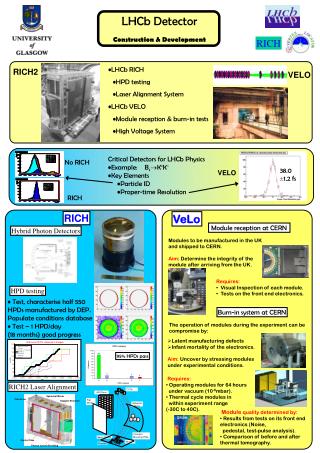
This document outlines the construction and testing procedures of Hybrid Photon Detector (HPD) modules for the LHCb experiment at CERN. Emphasizing the integrity and performance evaluation of HPDs manufactured in the UK, it details the visual inspection protocols, front-end electronics testing, and burn-in tests to mitigate risks associated with manufacturing defects. The significance of these detectors for precise particle identification and time resolution in LHCb physics is examined, alongside rigorous procedures such as thermal cycling and over 64-hour vacuum operation.

LHCb Detector Construction & Development
E N D
Presentation Transcript
LHCb Detector Construction & Development CCDs HPD Plane Spherical Mirror Flat mirror Flat Mirror Support Structure Spherical Mirror Common Mounting Plate Beam Splitter Central Tube Mirror Focuser Photon funnel+Shielding RICH • LHCb RICH • HPD testing • Laser Alignment System • LHCb VELO • Module reception & burn-in tests • High Voltage System RICH2 VELO • Critical Detectors for LHCb Physics • Example: BsK+K- • Key Elements • Particle ID • Proper-time Resolution No RICH 38.0 ±1.2 fs VELO RICH RICH VeLo Module reception at CERN Hybrid Photon Detectors Modules to be manufactured in the UK and shipped to CERN. Aim: Determine the integrity of the module after arriving from the UK. • Requires: • Visual Inspection of each module. • Tests on the front end electronics. HPD testing • Test, characterise half 550 HPDs manufactured by DEP. Populate conditions database • Test – 1 HPD/day • (18 months) good progress Burn-in system at CERN The operation of modules during the experiment can be compromise by: • Latent manufacturing defects • Infant mortality of the electronics. • Aim: Uncover by stressing modules under experimental conditions. 95% HPDs pass • Requires: • Operating modules for 64 hours • under vacuum (10-6mbar). • Thermal cycle modules in • within experiment range • (-30C to 40C). RICH2 Laser Alignment • Module quality determined by: • Results from tests on its front end electronics (Noise, • pedestal, test-pulse analysis). • Comparison of before and after thermal tomography.