Download
1 / 19
190 likes | 287 Vues
Learn how behavior changes through reinforcement, positive and negative reinforcers, punishment, and the Two-Factor Theory. Explore schedules of reinforcement and the Skinner Box in B.F. Skinner's study. Discover fixed-interval, variable-interval, fixed-ratio, and variable-ratio reinforcement techniques.

E N D
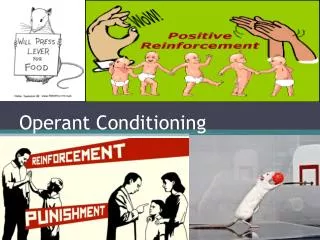
Operant Conditioning Behavior is changed by being REINFORCED!!!!
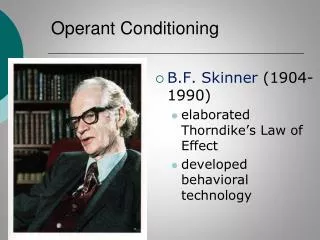
B. F. Skinner • Voluntary responses come to be controlled by their consequences • Tend to repeat responses that are followed by favorable consequences • Tend to avoid, or not repeat, responses that are followed by neutral or unfavorable consequences
Types of Reinforcers • Positive reinforcers increase the probability that a response will occur: • Money: job, grades, chores
Positive Reinforcers • Praise = increased effort • Attention = increased feelings of self-worth
Positive Reinforcers • Food – cool dog tricks • Clowning around – kids act up to see if bad behavior will get them some attention
Positive Reinforcers • Even bad behavior will get you some attention!
Types of Reinforcers • Negative Reinforcers • Increase the probability that a response or action will occur if the stimulus if removed • Calling in sick – reduces, removes, avoids or escapes the stimulus
Negative Reinforcers • Addicts take drugs and avoid withdrawal symptoms • You hit the snooze button and avoid getting up out of bed
Negative Reinforcers • Take aspirin to avoid or remove a headache
So….. • Both Positive and Negative reinforcers increase the frequency of a behavior!!!
Punishment???? • Punishment is used to decrease a behavior… • The presentation of a stimulus or event following a behavior that acts to decrease the likelihood of the behavior’s being repeated. • Teachers reprimand a misbehaving student • Friends make fun of your new outfit • Parents spank an unruly child
Two Factor Theory • Classical conditioning can create a phobia…
Two Factor Theory Operant conditioning can maintain a phobia through avoidance!
Schedules of Reinforcement • How can we increase the rate of response or make it more resistant to extinction? • Deliver the reinforcer at varying rates or intervals! • How are the schedules determined? • The interval of time between correct responses • The ratio of correct responses to reinforcers
Skinner Box • The experimental apparatus invented by B.F. Skinner to study the relationship between environmental events and active behaviors or when a reinforcer should be introduced
Fixed- Interval: Time • A fixed amount of time occurs between presentation of the reinforcer • Pigeon pecks at one minute intervals • Report cards mailed home every six weeks • ???
Variable Interval: Time • A variable amount of time elapses between presentation of reinforcers • Food pellets delivered at random times: pigeon pecks almost constantly • Pop quizzes • ???
Fixed-Ratio • The reinforcer is provided after a set number of correct response • Pellets delivered every 10th try: pigeon pecks constantly • $25 for every 5 phone calls • ???
Variable-Ratio • The reinforcer is provided randomly or after a variable number of correct responses • Pigeon pecks constantly • Slot Machines