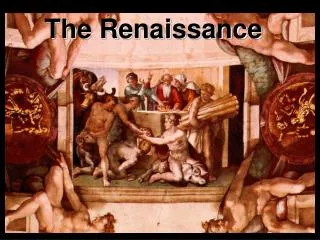
The Renaissance: A Flourishing Era of Art, Science, and Individualism in Europe
290 likes | 400 Vues
The Renaissance marked a pivotal shift in European history, emerging from the Dark Ages and characterized by a revival of classical ideas, exploration, and the rise of humanism. From the patronage of influential families like the Medici to the groundbreaking works of artists such as Michelangelo and Da Vinci, this era fostered unprecedented advancements in literature, science, and the arts. The emergence of universities and civic structures supported individualism and a questioning of societal norms, laying the foundation for modern Western thought.


The Renaissance: A Flourishing Era of Art, Science, and Individualism in Europe
E N D
Presentation Transcript
The renaissance • The Light at the end of the Dark Ages : • In Early 800’s, Charlemagne & descendants mandated the creation Schools & Universities • Exploration & Trading unites the continents • Marco Polo – Europe, Asia • Vikings – Europe, Asia, North America • Crusades – Europe, Asia • The Great Schism : The Church Divided • Two Popes ( 1 in Rome, Italy, 1 in Avignon, France ) • Both had claims to the papacy • Double Taxation • Religion becomes overly political • Increase level of Corruption • “buying” positions & “Selling” Indulgences • Illegitimate Children of Clerics
The renaissance • Europe stabilizes : • Governments take hold / provide civic functions ( I.E. schools ) • Cities begin to grow • Re-Establishment of the Service Sector and Trade • Humanism • Thinking & Acting for one’s self – individualism • Begin to question the norms of society & Religion • Stratification of classes – Introduction of a new Class ! • Upper Class – Royalty, Merchants, Bankers • New -Artisan Class – Highly skilled Craftsman & Artists • Lower Class – Farmers & laborers • Upper Class grows and widely supports the arts. • New Architecture is born • Concert Halls • Museums • Hotels
The renaissance • The Age of Enlightenment : • Explosion of Ideas • Science – Astronomy, physics, Calculus • Copernicus, Galileo, Newton • Fine Arts – Painting, Sculpture, Architecture • Da Vinci, Michelangelo, Rafael, Donatello • Literary Arts – Shakespeare, Machiavelli, Dante, Castiglione • Inventions – The Printing Press • Music – Dufay, Desprez • Religion – John Calvin, Martin Luther
The renaissance – The Patrons • French & British Aristocracy • Francis Sforza • The Borgia Family • The Medici Family • Earliest prominence in the late 12th Century – Florence, Italy • Made their money from banking & trade • Became rulers of the Region of Tuscany • Two Medici Popes – Leo X & Clement VII • Lorenzo di Medici set up artist schools in his court • Michelangelo • Donatello • Rafael • Boticelli
The renaissance – The Patrons • The Medici Family
The renaissance – Italian • The “Rebirth” • A return to Roman Classicism & the orders • Rigid Tradition • Manneristic • Freedom of Expression within the orders • Massivity in Design • Columns Grow Larger
The renaissance – The Architects • Filippo Brunelleschi (1377 – 1446) • sponsored by Medici • San Lorenzo 1421-1428 San Lorenzo Birdseye View San Lorenzo - Sacristy San Lorenzo - Nave
The renaissance – The Architects • Filippo Brunelleschi (1377 – 1446) • sponsored by Medici • Florence Cathedral 1420-1436 Florence Cathedral Florence Cathedral – interior of dome
The renaissance – The Architects • Leon Battista Alberti (1404 – 1472) • San Andrea ( 1471- San Andrea - Exterior San Andrea - Nave
The renaissance – The Architects • Leon Battista Alberti (1404 – 1472) • palazzo Rucellai ( 1455- 1471) • 4th Level • Servants quarters • 3rd Level • Bedrooms & studios • Piano Nobile • Salons, Dining Rooms • 1st Level • Entry, Kitchens, Utility Spaces Best example of the Renaissance Palazzo Palazzo Rucellai - Exterior
The renaissance – The Architects • Donato Bramante (1444 – 1514) • San Satiro ( 1476- 1482) • Bramante was the “Maestro”. He trained many architects. He influenced 3 generations of design. San Satiro - EXTERIOR San Satiro - Nave
The renaissance – The Architects • Donato Bramante (1444 – 1514) • Tempietto S. Pietro ( 1502 ) • Best Renaissance example of a rotonda church Tempietto - Section Tempietto - Exterior
The renaissance – The Architects • Antonio San Gallo ( 1484 – 1546 ) • Palazzo Farnese ( 1513-1589 ) • Son of Guiliano San Gallo, architect • Michelangelo took over all of his work after he died & changed it Farnese - Portico Farnese - Salon Farnese - Exterior
The renaissance – The Masterpiece • St. Peters Cathedral – The Vatican • The Papal Church • Later evolved into papal complex with Palazzo, Library, Museum, & Cloister Bramante - 1506 Bramante & Peruzzi - 1513 Piazza San pietro - 1602 San Gallo - 1539 Michelangelo - 1546
The renaissance – The Masterpiece • St. Peters Cathedral • Was first given to Bramante in 1506 by Pope Julius II • Bramante used the church to train other architects like Peruzzi, San Gallo, • 1539 Antonio San Gallo heads the design and starts to create a longer Nave to the west. • 1546 San Gallo dies, Michelangelo takes over both St. Peters and Farnese Palace at age of 71 • Michelangelo imparts his mannerisms onto the design and creates a large dome. He dies in 1564. Giacomo Della Porta finishes his dome • Carlo Maderno Finishes the Cathedral 1607 - 1626 San Pietro – Birdseye view
The renaissance – The Masterpiece • St. Peters Cathedral San Pietro – Nave looking east Because it was the church of the people they commissioned the best craftsmen & used the best materials. It also had to be massive in scale since it was the church that embodied God on earth. San Pietro – Nave looking west
The renaissance – The Masterpiece • St. Peters Cathedral - The Artistry The Pieta – Bernini 1657-1666 The Baldacchino – Bernini 1624-1633
The renaissance – The Masterpiece • St. Peters Cathedral - The Artistry Tomb of Paul III – della Porta 1551-1575 The Pieta – Michelangelo 1500 Tomb of Alexander VII – Bernini 1671-1678
The renaissance – High Period • Michelangelo ( 1475 – 1564 ) • Arguably the Greatest Artist of the time • Renaissance man – Painter, Sculptor, Architect, Engineer Stair - Laurentian Library -1524 New Sacristy - San Lorenzo –1519-1534
The renaissance – High Period • Andrea Palladio ( 1505 – 1580 ) • San Giorgio Maggiore • One of the few churched by Palladio. Known for his Villas. Did not fit with the religious format very well. • His Manneristic style is based on Symmetry. Churches are Assymmetrical Plan - St. Giorgio -1565 Nave - St. Giorgio -1565
The renaissance – High Period • Andrea Palladio ( 1505 – 1580 ) • Villa Rotunda - 1550 • The best example of the Italian Villa • Best suited for his symmetrical Mannerism • Worked with delineations of public & Private space Plan - Villa Rotunda Nave - St. Giorgio -1565
The renaissance – Italian Furnishings • Elaborately carved wood chairs & Chests. • Elaborately Carved Wood Four Poster beds on platforms • Ornate Marble Fireplace & Mantels • Silk, Velour, & Damask wall coverings • Decorative Metal Chandeliers Cassone Cassapanca Savonarolla chair
The renaissance – French • Started During the Italian High Period • Mostly by Aristocracy • Charles VIII attacked Naples in 1494 & returned with 22 Italian Craftsmen & Artisans • King Francis I visited Rome in 1515 & returned with Da Vinci • Climatic Differences – Gardens, Hearths • New style eclectic • Roman Classical • French Gothic • Castle Architecture • In General, French Renaissance Style is less consistent to the orders and exhibits less artistic license within the construct of the orders. Hotel villette - Paris
The renaissance – French • Italian- trained Architects at the start • Guiliano San Gallo • Sebastiano Serlio • Francesco Primaticco Ornate Wood Ceiling Elaborate Chandeliers Framed Painted Stucco Frescoes Ornate Wood Wainscot Herringbone Wood Flooring Place Fountainebleau – Primaticco 1533
The renaissance – French • The French Grand Master • Francois Mansart ( 1598 – 1667 ) • Chateau de Maisons 1642-1651 Chateau de Maisons – Exterior Chateau de Maisons – Plan Chateau de Maisons – Grande Salle
The renaissance – French • The French Grand Master • Francois Mansart ( 1598 – 1667 ) • Artistic Elegance • Correct use of Classicism • Manneristic • Roofs • Use of Orders - Romanesque Chateau maisons - orders Chateau maisons - Roof Val-de-Grace – alter 1645-1667
The renaissance – Spain • Started During the Italian High Period • Mostly by Aristocracy • New style eclectic • Roman Classical • French Gothic • Moorish Architecture (mudejar) • Two Distinct Styles • Plateresco Style 1475-1550 • Florid Designs in Gold & Silver – elaborate Metal work • Granada Cathedral • Desornamento • Stripped down & Austere • Highly Symmetrical • Mimicked Moorish Conservatism • Embraced by ruling Hapsburgs Granada Cathedral – Diego de Siloe 1529