Cell Respiration
This chapter delves into cellular respiration, outlining how energy from biomolecules (food) is harnessed to produce ATP. It differentiates between aerobic and anaerobic respiration, describing the processes involved. Aerobic respiration, utilizing oxygen, includes glycolysis, the Krebs Cycle, and oxidative phosphorylation, resulting in up to 30 ATP per glucose molecule. Anaerobic respiration occurs without oxygen, generating 2 ATP via glycolysis and lactate formation. The chapter highlights the efficient breakdown of glucose and other biomolecules, crucial for energy production in cells.

Cell Respiration
E N D
Presentation Transcript
Cell Respiration Chapter 5
Cellular Respiration • Release of energy in biomolecules (food) and use of that energy to generate ATP ENERGY (food) + ADP + Pi ATP • Two methods of breaking down food • Aerobic Respiration: oxygen utilizing • Anaerobic Respiration: no oxygen used
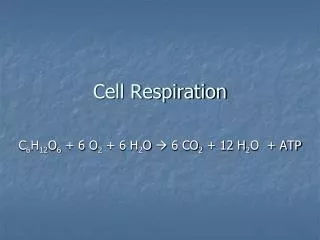
Aerobic Respiration • Uses oxygen in breakdown of materials and release of energy • C6H12O6 (glucose) + 6O2 6CO2 + 6H2O + Energy • Energy is released in small increments via long metabolic pathways • Allows cells to efficiently release and use energy contained in food molecules
Aerobic Respiration: Overview • Glycolysis • glucose pyruvate • Krebs Cycle • formation of electron carriers and CO2 • Oxidative Phosphorylation • electron carriers used to generate ATP
Glycolysis • Occurs in cytoplasm of the cell • Breakdown of one glucose molecule into two pyruvate molecules • Yields 2 ATP molecules (net) and 2 NADH molecules Fig 5.2
2ADP 2ATP Pyruvate (3C) Pyruvate (3C) 2ADP 2ATP Glycolysis NAD+NADH Glucose (6C) 2ATP 2ADP NAD+NADH NADH = high-energy electron carrier
Glycolysis • Glucose pyruvate • 2 NAD+ + 2H+ + 4e- 2 NADH • 2 ADP + 2 Pi 2 ATP
Kreb’s Cycle • Occurs in the mitochondrial matrix • Cyclical series of reactions Figs 5.7 & 5.10a
Krebs Cycle:Acetyl-CoA Formation • Pyruvate transported into mitochondrial matrix • CO2 cleaved off of pyruvate, forming acetate • Acetate linked to Coenzyme A (CoA) to form acetyl-CoA • One NADH formed for each pyruvate Fig 5.6
Krebs Cycle (The Cycle Itself) • Acetyl-CoA (2C) linked to oxaloacetic acid (4C), to form citric acid (6C) • Citric acid ultimately converted into oxaloacetic acid + 2CO2 • 1 GTP, 3 NADH and 1 FADH per each acetyl-CoA Fig 5.8
CO2 NAD+NADH Acetyl-CoA (2C) CO2 Oxaloacetate (4C) CO2 Krebs Cycle Citrate (6C) Pyruvate (3C) 3NAD+3NADH FAD+FADH2 GDP GTP FADH2 – high energy electron carrier GTP – similar to ATP, can be converted to ATP
Krebs Cycle • 3 CO2, 1 GTP, 4 NADH and 1 FADH2 produced for each pyruvate molecule. • Total: 6CO2, 2 GTP, 8 NADH, 2FADH2
Oxidative Phosphorylation • Occurs across the inner mitochondrial membrane • Electrons from NADH and FADH2 are transported along an electron transport chain • Energy released used to produce ATP Fig 5.10a
Oxidative Phosphorylation • H+ pumped from inside the membrane to the outside • forms [H+] gradient (more outside than inside) • H+ flows back in through ATP synthase • generates ATP • Electrons and H+ received by O2 • forms H2O Fig 5.10b
Overall Reaction for Aerobic Respiration C6H12O6 + 6O2 6CO2 + 6H2O
How Much ATP is Produced Per Glucose Molecule? Glycolysis 2 ATP Krebs Cycle (2 GTP) 2 ATP Oxidative Phosphorylation 26 ATP TOTAL30 ATP
Triglyceride Catabolism Figs 5.11 & 5.13 • Fatty acids are converted into acetyl-CoA • Large amounts of ATP produced per fatty acid
Amino Acid Catabolism Fig 5.16 Different amino acids can be converted into various Krebs Cycle intermediates
Anaerobic Respiration • Produce ATP in the absence of O2 • Used regularly by skeletal muscle fibers and RBCs • Two steps: • Glycolysis - produce ATP • Lactate Formation – regenerate NAD+
Glycolysis in Anaerobiosis • Glucose Pyruvate • Net 2 ATP produced • NAD+ NADH • Need NAD+ to drive glycolysis! Fig 5.2
Lactate Formation • Pyruvate Lactate • NADH NAD+ • Glycolysis can continue Fig 5.3
How Much ATP is Produced Per Glucose Molecule? Glycolysis 2 ATP TOTAL2 ATP • Most of the energy from glucose is still present in the lactate • Lactate accumulation leads to pH