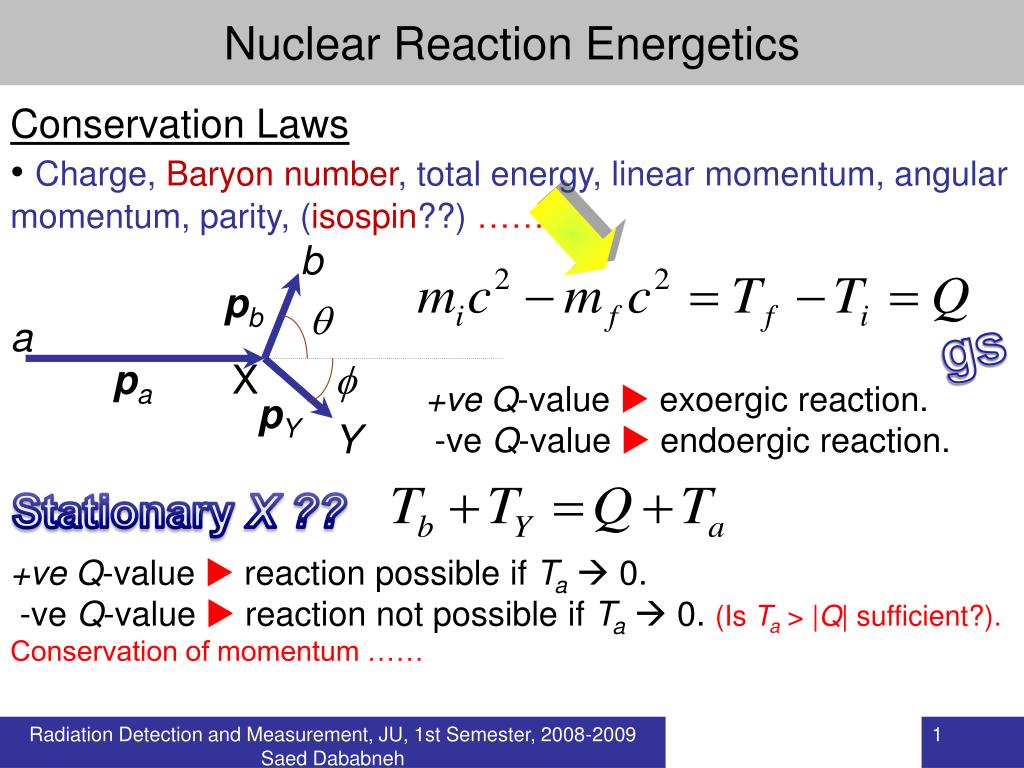
Nuclear Reaction Energetics • Conservation Laws • Charge, Baryon number, total energy, linear momentum, angular momentum, parity, (isospin??)……. b pb gs a pa X +ve Q-value exoergic reaction. -ve Q-value endoergic reaction. pY Y Stationary X ?? +ve Q-value reaction possible if Ta 0. -ve Q-value reaction not possible if Ta 0. (Is Ta > |Q| sufficient?). Conservation of momentum …… Radiation Detection and Measurement, JU, 1st Semester, 2008-2009 Saed Dababneh
Nuclear Reaction Energetics HW b1 • Conservation of momentum. • We usually do not detect Y. • Show that: • The threshold energy (for Ta): (the condition occurs for = 0º). • +ve Q-value reaction possible if Ta 0. • Coulomb barriers…….!!! • Neutrons vs. charged particles. • -ve Q-value reaction possible if Ta> TTh. double valued !? solve for Q Q < 0 Radiation Detection and Measurement, JU, 1st Semester, 2008-2009 Saed Dababneh
Nuclear Reaction Energetics HW b1(continued) • The double valued situation occurs between TTh and the upper limit Ta\. • Double-valued in a forward cone. Q < 0 Radiation Detection and Measurement, JU, 1st Semester, 2008-2009 Saed Dababneh
Nuclear Reaction Energetics HW b1(continued) • Discuss the elasticand inelastic scatteringof neutronsusing these relations. • If the reaction reaches excited states of Y Radiation Detection and Measurement, JU, 1st Semester, 2008-2009 Saed Dababneh
Nuclear Reaction Energetics Radiation Detection and Measurement, JU, 1st Semester, 2008-2009 Saed Dababneh
Nuclear Reaction Energetics Radiation Detection and Measurement, JU, 1st Semester, 2008-2009 Saed Dababneh
Nuclear Reaction Energetics Radiation Detection and Measurement, JU, 1st Semester, 2008-2009 Saed Dababneh
Nuclear Reaction Energetics Radiation Detection and Measurement, JU, 1st Semester, 2008-2009 Saed Dababneh
Neutron Interactions • Chadwick’s discovery. • Neutrons interact with nuclei, not with atoms. (Exceptions). • Recall: • Inelastic scattering (n,n\). Q = -E* Inelastic gammas. Threshold? • Elastic scattering (n,n). Q = ?? (Potential and CN). Neutron moderation? • Radiative capture (n,). Q = ?? Capture gammas. • (n,), (n,p). Q = ?? Absorption Reactions. • (n,2n), (n,3n) Q = ?? Energetic neutrons on heavy water can easily eject the loosely bound neutron. • Fission. (n,f). • HW b2Examples of such exo- and endo-thermic reactions with Q calculations. Non-elastic Radiation Detection and Measurement, JU, 1st Semester, 2008-2009 Saed Dababneh
Radiation Detection and Measurement, JU, 1st Semester, 2008-2009 Saed Dababneh
n-TOF CERN Radiation Detection and Measurement, JU, 1st Semester, 2008-2009 Saed Dababneh
Radiation Detection and Measurement, JU, 1st Semester, 2008-2009 Saed Dababneh
Reaction Cross Section • Probability. • Projectile a will more probably hit target X if area is larger. • Classically: = (Ra + RX)2. • Classical = ??? (in b)n+ 1H, n + 238U, 238U + 238U • Quantum mechanically: = 2. • Coulomb and centrifugal barriers energy dependence of . • What about neutrons? Radiation Detection and Measurement, JU, 1st Semester, 2008-2009 Saed Dababneh
Neutron Induced Reactions X(n,b)Y b(Q+En) n(En) Probability to penetrate the potential barrier Po(Ethermal) = 1 P>o(Ethermal) = 0 For thermal neutrons Q >> En b(Q) constant Non-resonant Radiation Detection and Measurement, JU, 1st Semester, 2008-2009 Saed Dababneh
Neutron Induced Reactions Radiation Detection and Measurement, JU, 1st Semester, 2008-2009 Saed Dababneh
Nuclear Fission 1/v Fast neutrons should be moderated. 235U thermal cross sections fission 584 b. scattering 9 b. radiative capture 97 b. Fission Barriers Radiation Detection and Measurement, JU, 1st Semester, 2008-2009 Saed Dababneh
Resonance Reactions J Ex a + X Y + b Q > 0 b + Y X + a Q < 0 Excited State Entrance Channel a + X Exit Channel b + Y Inverse Reaction Compound Nucleus C* Identical particles • Nature of force(s). • Time-reversal invariance. Statistical Factor () QM Radiation Detection and Measurement, JU, 1st Semester, 2008-2009 Saed Dababneh
Resonance Reactions Projectile Projectile Target Target Q-value Q-value Q + ER = Er E = E + Q - Eex Direct Capture (all energies) Resonant Capture (selected energies with large X-section) Radiation Detection and Measurement, JU, 1st Semester, 2008-2009 Saed Dababneh
Radiation Detection and Measurement, JU, 1st Semester, 2008-2009 Saed Dababneh
Resonance Reactions Damped Oscillator Oscillator strength Damping factor eigenfrequency Radiation Detection and Measurement, JU, 1st Semester, 2008-2009 Saed Dababneh
Resonance Reactions Breit-Wigner formula • All quantities in CM system • Only for isolated resonances. Reaction Elastic scattering Usually a>> b. HW b3When does R take its maximum value? Radiation Detection and Measurement, JU, 1st Semester, 2008-2009 Saed Dababneh
Neutron Resonance Reactions Radiation Detection and Measurement, JU, 1st Semester, 2008-2009 Saed Dababneh
Neutron Activation Analysis (Z,A) + n (Z, A+1) - (-delayed -ray) (Z+1, A+1) Radiation Detection and Measurement, JU, 1st Semester, 2008-2009 Saed Dababneh
Neutron Moderation Show that, after elastic scattering the ratio between the final neutron energy E\ and its initial energy E is given by: For a head-on collision: After ns-wave collisions: where the average change in lethargy is HW b4 1H ? Collision Parameter Reference Average decrease in ln(E) after one collision. Radiation Detection and Measurement, JU, 1st Semester, 2008-2009 Saed Dababneh
Neutron Moderation • Reproduce the plot. • Discuss the effect of the thermal motion of the moderator atoms. On 12C. Most probable and average energies? Radiation Detection and Measurement, JU, 1st Semester, 2008-2009 Saed Dababneh
Neutron Moderation • How many collisions are needed to thermalize a 2 MeV neutron if the moderator was: • 1H 2H 4He graphite 238U ? • What is special about 1H? • Why we considered elastic scattering? • When does inelastic scattering become important? Radiation Detection and Measurement, JU, 1st Semester, 2008-2009 Saed Dababneh