RTI: Backwards Implementation
This resource outlines effective strategies for implementing a Response to Intervention (RTI) framework, detailing a backward approach to design. It encompasses three tiers of instruction: Tier One for all students, Tier Two for targeted interventions, and Tier Three for intensive support. The document emphasizes the importance of data-driven decision-making, sustainable practices, and equitable discipline across schools. By reviewing and synthesizing school-based triangles using a rubric, educators can identify common challenges and strengths, ensuring that all students receive the necessary support for academic and behavioral success.

RTI: Backwards Implementation
E N D
Presentation Transcript
Willa M. Campbell, PhD Educational Access Solutions RTI: Backwards Implementation
ACADEMICBEHAVIOR Core Curriculum Behavior plan Assessments Interventions Instruction Incentives Support systems Consequences Educational Access Solutions, 2011 THE BASICS OF RTI
Educational Access Solutions, 2011 RTI: Integrated model PRACTICE DATA SYSTEMS
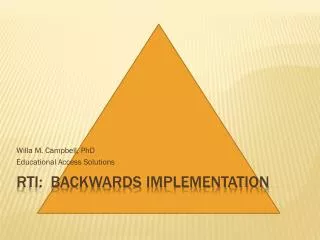
Tier Three - Intensive instruction and intervention. Small group or one-on-one instruction. Provided IN ADDITION TO core instruction. Tier Two - Strategic instruction and intervention. Targets a skill deficit within a specified timeline. Provided IN ADDITION TO core instruction. 10-15% of students. Tier One - Core instruction all students receive. Intended to advance students academically and behaviorally. 80-90% of students. Educational Access Solutions, 2011 Adapted from RTI Action Network, 2011
Educational Access Solutions, 2011 Rti: backwards implementation - aNALYSIS • SMALL GROUP ANALYSIS • Independently review the school-based triangles with the rubric, looking for: • Elements of sustainability • Common threads across schools • Evidence of equitable discipline • Missing components • As a group, discuss and summarize your findings on the chart pack and report out. • TASKS • Independently review the school-based triangles with the rubric, looking for: • Elements of sustainability • Common threads across schools • Missing components • As a group, summarize your findings on the chart pack and report out.
Educational Access Solutions, 2011 Rti: backwards implementation - SYNTHESIS • TABLE DISCUSSION • How does your analysis of the school-based RTI triangles support the sustainability of behavior support at the school level? If you don’t see adequate support, what do you recommend? • As a group, summarize your findings on the chart pack and report out.
www.rtinetwork.org Educational Access Solutions, 2011 Rti: The integration Challenge • BEHAVIOR RTI • Schoolwide climate • evaluation • Apply universal supports • Identify students who do • not respond • ACADEMIC RTI • Individual screening for • skill deficits • Individual data drive • universal interventions
Educational Access Solutions, 2011 Rti: backwards implementation