Download
1 / 9
90 likes | 226 Vues
This document explores the properties of modular arithmetic involving prime numbers, specifically in the context of RSA encryption. We prove that if n = p * q (where p and q are prime), then for a relatively prime integer a, several congruences can be deduced: ( a^{phi(n)} equiv 1 mod p ) and ( mod q ). The paper also demonstrates how ( a^{m+1} equiv a mod p ) and ( a^{m+1} equiv a mod q ) hold true, where gcd(a, n) = 1. This analysis is crucial for ensuring the security of RSA encryption systems.

E N D
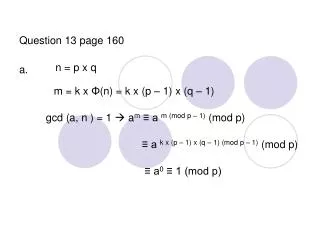
Question 13 page 160 n = p x q a. m = k x Φ(n) = k x (p – 1) x (q – 1) gcd (a, n ) = 1 am≡ a m (mod p – 1) (mod p) ≡ a k x (p – 1) x (q – 1) (mod p – 1) (mod p) ≡ a0 ≡ 1 (mod p)
n = p x q m = k x Φ(n) = k x (p – 1) x (q – 1) gcd (a, n ) = 1 am≡ a m (mod p – 1) (mod q) ≡ a k x (p – 1) x (q – 1) (mod q – 1) (mod q) ≡ a0 ≡ 1 (mod q)
First, we prove that: If n = p x q, p and q are primes Then a Φ(n) ≡ 1 (mod p) if a and p are relatively prime ≡ 0 (mod p) if a and p are not relatively prime And a Φ(n) ≡ 1 (mod q) if a and q are relatively prime ≡ 0 (mod q) if a and q are not relatively prime • Proof: • If a and n are relatively prime • a Φ(n) ≡ a Φ(n) (mod p – 1) (mod p) ≡ a (p – 1) x (q – 1) (mod p – 1) (mod p) ≡ a0 ≡ 1 (mod p) Similar proof for q If gcd(a,p) = b ≠ 1 As p is prime a = c x p and b = p So a Φ(n)≡ (cp) Φ(n)≡ 0 (mod p) and a ≡ cp ≡ 0 (mod p) Similar proof for q
b. Prove that : a m + 1≡ a (mod p) for all a • a m + 1≡ a kΦ(n) + 1 (mod p) • ≡ (a kΦ(n) (mod p) x a (mod p)) (mod p) • ≡ (a k ) Φ(n) (mod p) x a (mod p)) (mod p) • ≡ 1 x a (mod p) if ak and p are relatively prime • ≡ a (mod p) • If ak and p are not relatively prime • (ak)Φ(n)≡ 0 (mod p) (proven above) And a ≡ 0 (mod p) (proven above) • a m + 1 ≡ 0 x 0 ≡ 0 (mod p) • a m + 1 ≡ a ≡ 0 (mod p)
Prove that: a m + 1≡ a (mod q) for all a • a m + 1≡ a kΦ(n) + 1 (mod q) • ≡ (a kΦ(n) (mod q) x a (mod q)) (mod q) • ≡ (a k ) Φ(n) (mod q) x a (mod q)) (mod q) • ≡ 1 x a (mod q) if ak and q are relatively prime • ≡ a (mod q) • If ak and q are not relatively prime • (ak)Φ(n)≡ 0 (mod q) And a ≡ 0 (mod q) • a m + 1 ≡ 0 x 0 ≡ 0 (mod q) • a m + 1 ≡ a ≡ 0 (mod q)
c. Prove that: a ed≡ a (mod n) for all a Recall that d is chosen such that ed ≡ 1 (mod (p – 1) x ( q – 1)) ≡ 1 (mod Φ(n)) a ed≡ a kΦ(n) + 1 (mod n)
a ed≡ a kΦ(n) + 1≡ a (mod p) (proven before) (1) a ed≡ a kΦ(n) + 1≡ a (mod q) (proven) (2) (1) a ed= u x p + a • a ed – a = u x p , u is integer However, (2) a ed = v x q + a a ed – a = v x q , v is integer • u x p = v x q u = (v x q) / p As p, q are primes, so q/p cannot be integer, and u is an integer v/p is integer v = t x p • a ed = v x q + a = t x p x q + a a ed≡ a (mod p x q)
d. gcd(a, n) = 1, n = p x q p, q are large primes assume gcd(a,n) = b a = u x b = p x q in order that b ≠ 1: b = p or b = q or b = p x q for gcd(a, n) ≠ 1 : a = k x p or a = k x q Large p p 2p 3p 4p 5p Small p
As p and q are large primes, within a certain bound of values, the number of values that makes gcd(a, n) ≠ 1 is small i.e. the number of values between 2 consecutive numbers that make gcd(a, n) ≠ 1 is large • With large primes p and q, and we randomly choose a, then gcd(a, n) is likely to be 1













![Cisco 300-160 Dumps Question - Data Networking [300-160] Exam Question](https://cdn4.slideserve.com/7938520/questions-answers-pdf-dt.jpg)