ROOFS
ROOFS. ROOF. GENERAL FUNCTION: To give a protective covering to the building, so rain, wind or snow may not damage the building. Functional requirements. Weather resistance Structural stability Provide good appearance Provide thermal insulation. Functional Requirements (cont’d).
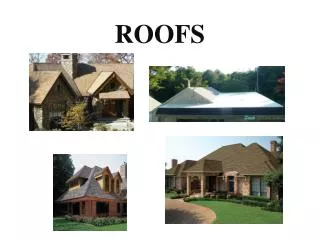

ROOFS
E N D
Presentation Transcript
ROOF • GENERAL FUNCTION: • To give a protective covering to the building, so rain, wind or snow may not damage the building Functional requirements • Weather resistance • Structural stability • Provide good appearance • Provide thermal insulation
Functional Requirements (cont’d) Weather Resistance • Required to protect a building from the damaging effects of rain & wind • The ingress of rain: causes damage to decorations & structural damage to timber due to attacks by fungus & insects • The roof is covered by a layer of impermeable material which prevents the passage of rain into a building • The deflection of building may be cause of wind
Functional Requirements (cont’d) Structural Stability • Provide support for the roof covering • In designing a roof structure, the designer must take into consideration the span of structural members • If span at joist too great will cause bending • To overcome : introducing a structural element which reduces the span
Functional Requirements(cont’d) Provide Good Appearance • Might be a major visual element in the design of a building • The detailing of roof can significantly affect the appearance of a building
Functional Requirements (cont’d) Provide Thermal Insulation • Roof represents a large proportion of the external surface area of a building has potential for heat loss. • Pitched roofs are usually insulated between the ceiling joists • Alternative insulation might be applied between rafters • Flat roof insulation is usually laid above the decking, either below or above the roof covering
SLOPING ROOF / PITCHED ROOF • Sloping roof may be categorized into: • Medium to high slope – 4:12 to 12:12 • Low slope - up to 3:12 • Sloping roofs shed water easily to eave gutters (drain/sewer). • Roof height & area increase with its horizontal dimension
This type of roof depends on:- • Area covered • Materials available • Type of lighting • Ventilation needed inside • Available appliance
Shed Gable Hip Gambrel Mansard Saw tooth
SLOPING ROOF (cont’d) • Sloping roofs may have a structure of: • Rafters & sheathing • Beams, purlins & decking • Trusses
SLOPING ROOF (cont’d) • Medium & high slope roofs may be covered with shingles, tiles or sheet materials • Low slope roofs require roll or continuous membrane roofing; some shingle & sheet materials may be used on 3:12 pitches • The roof slope also affects the design loads. • Slope roof planes may be combined to form a variety of roof forms
FLAT ROOFS • Pitch from 0 to 10 degree • Slope may be achieved by sloping the structural members or by tapering the deck or rigid insulation • Slope usually leads to interior drains; perimeter scuppers can be used as overflow drains
FLAT ROOFS (cont’d) • Roof structure may consist of:- • Joist & sheathing • Beams & decking • Flat trusses • Concrete slabs • Flat roofs require continuous membrane roofing Deck
Shell Roof • A thin shell is defined as a shell with a thickness which is small compared to its other dimensions and in which deformations are not large compared to thickness • These elements are typically curved and are assembled to large structures. Example: factories and roof structures in some buildings. • Advantage in construction : a lot of material is saved as the section needed is very thin.
Domes • A roof of semi-spherical or semi elliptical shape • Constructed of stone or brick or concrete, & supported on circular or regular polygon shaped walls • The structure is such that within certain height & diameter ratios, very small thickness is needed
Common Term Used Ridge
ROOF COVERINGS • Is a materials which gives a protective surface to the roofing structure • The function is only to prevent ingress or egress of heat & moisture into the building • Various types of coverings depending on :- • The character of the building • The type of the roofing structure • Local conditions, cost, etc.
Types of Roof Coverings • Thatch- is the craft of building a roof with dry vegetation such as straw, water reed, sedge, rushes, or heather. Now become choice for rustic look and more ecologically friendly roof. • Wood-thin, tapered pieces of wood primarily used to cover roofs and walls of buildings to protect them from the weather • Shingles-roof covering consisting of individual overlapping elements. Can be made of various materials such as wood, composite or ceramic. Thatch Wood
4. Tiles-made of a ceramic material and is hard and brittle, poorly suited for places where tree limbs can fall on a house's roof. 5. Slates -is a fine-grained, foliated, homogeneous metamorphic rock derived from an original shale-type sedimentary rock composed of clay or volcanic ash 6. Asphalt – known as bitumen, viscous liquid or semi solid form of petroleum. Tiles
Asbestos cement sheets-known as fibre cement sheet. It is a building material in which asbestos (silicate mineral) fibres are used to reinforce thin rigid cement sheets. • Corrugated iron sheets-The corrugations increase the bending strength of the sheet. Normally each sheet is manufactured longer in its strong direction. 9. Bituminous felt-bitumenmixed with a filler component such as limestone or sand or polymers to gives rigidity and tear resistance. 10. Sheet metal roof coverings (copper, zink, etc.)-roofing system made from metal piece, or tiles. Asbestos
ROOF DESIGN & CONSTRUCTION FACTORS • Roof structure must be designed to carry: • Dead loads – roof structure, deck, insulation, roofing & any equipment located on top of or suspended from roof • Live loads – accumulated rain, snow & ice & traffic if any. • Wind loads – pressure or suction from wind • Type of roofing required against: • Surface water from the outside • Water vapor diffusion from the inside • Moist air flow • Heat flow & solar radiation