Understanding Fiscal Policy: Automatic Stabilizers vs. Discretionary Spending
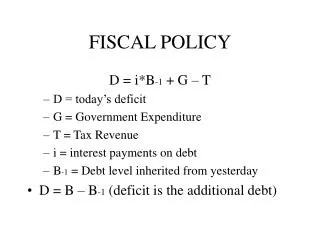
This overview explores the concepts of fiscal policy, focusing on automatic stabilizers and discretionary spending. Automatic stabilizers help stabilize the economy through government revenue and expenditure adjustments tied to the business cycle, while discretionary spending involves deliberate government investment, such as in infrastructure, aimed at influencing economic activity. The discussion also highlights challenges, including high government borrowing and "crowding out," which occurs when increased government expenditure raises borrowing costs for the private sector. The impact of fiscal austerity and long-term debt trends in the UK are examined.

Understanding Fiscal Policy: Automatic Stabilizers vs. Discretionary Spending
E N D
Presentation Transcript
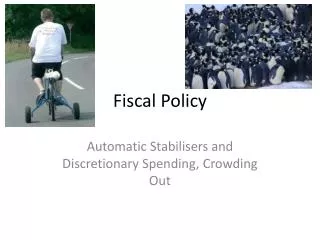
Fiscal Policy Automatic Stabilisers and Discretionary Spending, Crowding Out
Automatic stabilisers? • “process by which govt. expenditure and revenue vary with the business cycle, thereby helping to stabilise the economy without any conscious intervention from government”
Discretionary fiscal policy? • “government spending on infrastructure that takes place in an attempt to deliberately attempt to influence the course of the economy”
How much borrowing can the UK take? Government debt is rising but long term bond yields remain low Fiscal austerity as Coalition aims to cut the size of the budget deficit over the next five years – will the pain work? Accusations that Labour failed to ‘save for a rainy day’ in the good times : TOO MUCH DISCRETIONARY SPENDING?
Problem of High Govt Borrowing : “Crowding out” • Three groups • Investors/Bankers • Governments • Businesses
Instructions for Investors/Bankers • Lend your money • Prioritise the governments since they offer the safest investment • Lend any remaining money to businesses
Instructions for governments • Borrow money from the investors/bankers • In round 1 seek to borrow 5 million each • In round 2 seek to borrow 8 million each
Instructions for businesses • Borrow money from the investors/bankers • In each round seek to borrow 5 million
I.O.U. £1 million. I will pay you back in 10 years time and promise to pay 2.5% interest every year until then.
Crowding Out: Process by which an increase in government expenditure ‘crowds out’ private sector activity by increasing the price of borrowing