Normalization
This comprehensive overview of database normalization covers the various normal forms—1NF, 2NF, 3NF, and BCNF—and their roles in minimizing redundancy. It explains the significance of functional dependencies (FDs) in detecting redundancies and introduces examples to clarify concepts. The discussion also highlights the challenges associated with schema decomposition, including potential performance impacts and issues related to lossless-join and dependency preservation. By understanding these principles, database designers can create efficient and reliable relational databases.


Normalization
E N D
Presentation Transcript
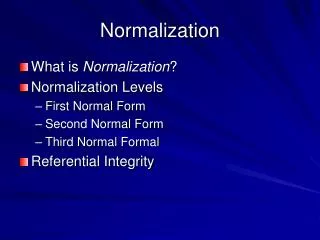
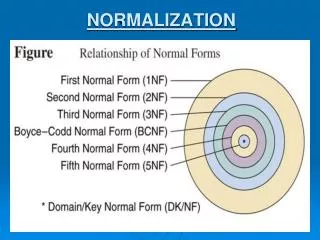
Normal Forms • If a relation is in a certain normal form(BCNF, 3NF etc.), it is known that certain kinds of redundancies are avoided/minimized. This can be used to help us decide whether decomposing the relation will help. • Role of FDs in detecting redundancy: • Consider a relation R with 3 attributes, ABC. • Given A BC: There is no redundancy here. • Add B C: Several tuples could have the same B value, and if so, they’ll all have the same C value!
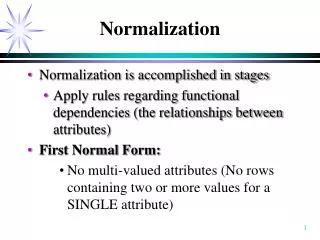
First Normal Form (1NF) • 1NF: Each field is an atomic (scalar) value • All relations are in first normal form (1NF) • Some definitions we’ll need to understand the other normal forms: • A prime attribute is an attribute that is an element of one or more CKs for a relation. • A trivial FD is one in which the RHS is contained in the LHS (e.g., AB A or B B). We will ignore such FDs in this lecture.
Second Normal Form (2NF) • Relation R is in 2NF if, for all FDs X A • A is prime, or • X is not a proper subset of any CK. • Example: R = (part, wh, qty, wh-addr) • FDs: {part, wh} qty wh wh-addr • Is R in 2NF?
2NF (continued) • No, it’s in 1NF only. Only candidate key is {part, wh}, and second FD violates 2NF. • So what? • We’re storing wh-addr once for each part stored at that warehouse. • Solution: R1 ( ) and R2 ( ) • Are R1, R2 in 2NF?
Third Normal Form (3NF) • Relation R is in 3NF if, for all FDs X A • X is a superkey for R, or • A is prime • Example: ED = (enum, ename, sal, dnum, dname, mgr) • FDs: enum ename, sal, dnum dnum dname, mgr • Is ED in 2NF? 3NF? • The problem: stored for each employee in a department
3NF (continued) • One solution: • Emp (enum, ename, sal, mgr) • Dept (dnum, dname, mgr) • Removes the redundancy • A problem remains: • This is an example of a lossy-join decomposition, which is avoidable in 3NF. • Use Emp1 (enum, ename, sal, ) instead of Emp.
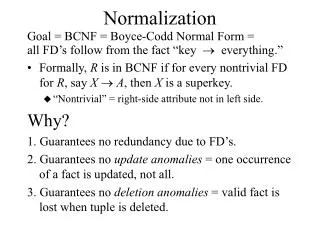
Boyce-Codd Normal Form (BCNF) • Relation R is in BCNF if, for all FDs X A • X is a superkey • Example: R = (branch, cust, banker) • FDs: banker branch cust, branch banker • Is R in 3NF? BCNF? • Problems: • Bankers must have at least one customer • Branch stored redundantly for each of a banker’s customers
BCNF (continued) • Decomposition: R1 (banker, branch) and R2 (cust, banker) • avoids redundancy and other problems • A problem remains: • In this case, no dependency-preserving decomposition into BCNF is possible.
Problems with Decompositions • There are three potential problems to consider: • Some queries become more expensive. • e.g., find employee and department names • Given instances of the decomposed relations, we may not be able to reconstruct the corresponding instance of the original relation! • First 3NF decomposition attempt • Checking some dependencies may require joining the instances of the decomposed relations. • BCNF decomposition example • Tradeoff: Must consider these issues vs. redundancy.
Summary of Schema Refinement • If a relation is in BCNF, it is free of redundancies that can be detected using FDs. • If a relation is not in BCNF, we can try to decompose it into a collection of BCNF relations: • Lossless-join, dependency preserving decomposition into BCNF is not always possible • Lossless-join decomposition into BCNF is always possible • Lossless-join, dependency preserving decomposition into 3NF is always possible • Decompositions should be carried out and/or re-examined while keeping performance requirements in mind. • Various decompositions of a single schema are possible.