
SlideServe
Menu
Préférences
© SlideServe · v2026

Indirect Measurement: Using a Hypsometer

adonis avatar
5 diapositives · 471 Views · Sep 01, 2014

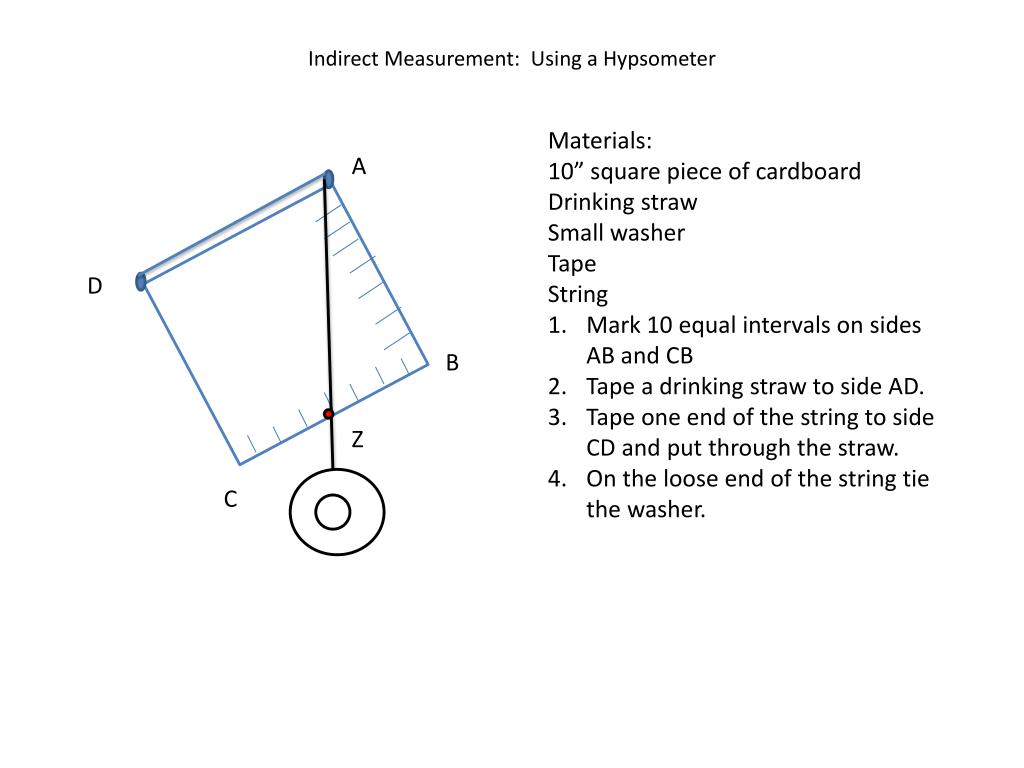
Indirect Measurement: Using a Hypsometer. Materials: 10” square piece of cardboard Drinking straw Small washer Tape String Mark 10 equal intervals on sides AB and CB Tape a drinking straw to side AD. Tape one end of the string to side CD and put through the straw.
Indirect Measurement: Using a Hypsometer - slide 1
01 / 5Indirect Measurement: Using a Hypsometer
1 / 17

Télécharger la présentation

Indirect Measurement: Using a Hypsometer
Une image / un lien ci-dessous est fourni (tel quel) pour télécharger la présentation

Politique de téléchargement : le contenu du site vous est fourni TEL QUEL pour votre information et votre usage personnel ; il ne peut être vendu, concédé sous licence ni partagé sur d’autres sites sans l’accord de son auteur.Le contenu vous est fourni TEL QUEL, pour votre information et votre usage personnel uniquement. Téléchargez la présentation en cliquant sur ce lien. Lors du téléchargement, si vous ne parvenez pas à télécharger une présentation, l’éditeur a peut-être supprimé le fichier de son serveur.Pendant le téléchargement, si vous ne parvenez pas à obtenir une présentation, le fichier a peut-être été supprimé par l’éditeur.

F I N

Plus de contenu associé

Transcription de la présentation
  1. Indirect Measurement: Using a Hypsometer • Materials: • 10” square piece of cardboard • Drinking straw • Small washer • Tape • String • Mark 10 equal intervals on sides AB and CB • Tape a drinking straw to side AD. • Tape one end of the string to side CD and put through the straw. • On the loose end of the string tie the washer. A D B Z C

  2. How to Use the Hypsometer R • Segment RG represents the object you are going to measure. Point D is the location of your eye when you position the hypsometer. Point H is the location of your feet. • Hold the hypsometer, viewing through point D and looking-up with point A (on the hypsometer) directed towards the top of the object (point R). Point D on both the drawings are the same point! • Hold the string down tight to the cardboard so that you can note the distance from point B to Z (on the hypsometer). Mark this distance on the appropriate column on the Data Table. Q G D H • When marking the distances, in the Data Table from points A to B should be the same for all your objects measured. • Using the tape measure, measure the distance from points G to H. Enter that distance in the appropriate column of the Data Table. • Measure the distance from points D to H. Enter that distance in the appropriate column of the Data Table.

  3. Person with Hypsometer__________________________Recorder_________________________ Complete the calculations for each row in the table and attach your work. Use the following formula to calculate the value of QR: Calculate the height of the object (RG) by adding DH and QR.

  4. Please respond to the following questions in complete sentences . Share your responses with me as a Google Document titled: Grade 9_first name last name_Hypsometer Activity. I WON’T GRADE IT IF IT IS NOT TITLED CORRECTLY. • Why does this method of measurement with the hypsometer work and how does it apply to what we learned in class? Write a minimum of 5 sentences. • Why is it important to have the same person hold the hypsometer when you are measuring? Write a minimum of 3 sentences. • How accurate were your measurements? Why? Write a minimum of 5 sentences. • What improvements could you make ? How would these changes improve the activity? Write a minimum of 7 sentences. • How are the same principles used in the activity applied in real life? Write a minimum of 5 sentences.

  5. Grading • Criterion A: Table and your calculations. 8 points • Criterion B: Questions 1 and 2. 8 points • Criterion D: Questions 3, 4 and 5. 6 points • I would advise you to look at what is expected to earn the maximum points by reading over the criteria at mrsriegels.weebly.com under the MYP tab. • The sentence requirement is a minimum. The more detail and explanation you give, the better.