Understanding Water Chemistry and Buffer Solutions in Biological Systems
This comprehensive overview covers the molecular nature of water, focusing on noncovalent bonding, ionic interactions, hydrogen bonds, and van der Waals forces. It explores water's unique thermal and solvent properties, the behavior of hydrophilic, hydrophobic, and amphipathic molecules, and osmotic pressure. The chapter also delves into the ionization of water, the concepts of acids, bases, and pH, as well as buffer solutions and their physiological importance. Key equations like the Henderson-Hasselbalch equation are explained, along with practical applications in titration and buffer calculations.

Understanding Water Chemistry and Buffer Solutions in Biological Systems
E N D
Presentation Transcript
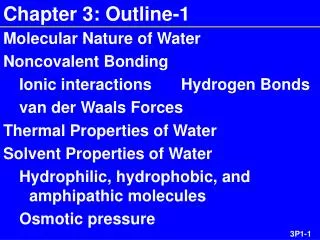
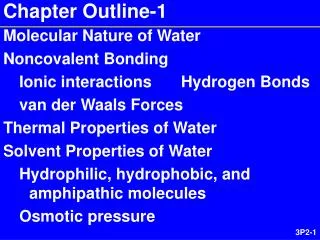
Chapter Outline-1 • Molecular Nature of Water • Noncovalent Bonding • Ionic interactions Hydrogen Bonds • van der Waals Forces • Thermal Properties of Water • Solvent Properties of Water • Hydrophilic, hydrophobic, and amphipathic molecules • Osmotic pressure
Chapter Outline-2 • Ionization of Water (We are here.) • Acids, bases, and pH • Buffers • Physiological buffers
3.5 (cont.) Monitoring Acidity • The Henderson-Hasselbalch (HH) equation is derived from the equilibrium expression for a weak acid.
Monotoring Acidity-2 • The HH equation enables us to calculate the pH during a titration and to make predictions regarding buffer solutions. • What is a titration? • It is a process in which carefully measured volumes of a base are added to a solution of an acid in order to determine the acid concentration.
Monotoring Acidity-3 • When chemically equal (equivalent) amounts of acid and base are present during a titration, the equivalence point is reached. • The equivalence point is detected by using an indicator chemical that changes color or by following the pH of the reaction versus added base, ie. a titration curve.
Titration Curve (HOAc with NaOH) pH moles OH- per mole acid
Titration Curve (HOAc with NaOH)-2 • At the equivalence point, only the salt (NaOAc) is present in solution. • At the inflection point, equal moles of salt and acid are present in solution. • [HOAc] = [NaOAc] • pH = pKa
Titration Curve (HOAc with NaOH)-3 • The pKa for acetic acid is 4.76. • 1. Calculate the relative percents of acetic acid and acetate ion when the acid is titrated with 0.7 equivalents of NaOH. • 2. Use the Henderson-Hasselbalch equation to calculate the pH at this point. (Click for answer.)
Titration Curve (HOAc with NaOH)-4 • 0.7 equivalents of NaOH neutralizes 0.7 eq of acid producing 0.7 eq of salt and leaving 0.3 eq of unneutralized acid. • pKa of HOAc is 4.76 30% acid and 70% salt. pH=5.13
Buffer Solutions • Buffer: a solution that resists change in pH when small amounts of strong acid or base are added. • A buffer consists of: • a weak acid and its conjugate base or • a weak base and its conjugate acid
Buffer Solutions-2 • Maximum buffer effect occurs at the pKa for an acid. • Effective buffer range is +/- 1 of the pK value for the acid or base. • eg. H2PO4-/HPO42-, Ka=7.20 • buffer range 6.20-8.20 pH
Buffer Solutions-3 • High concentrations of acid and conjugate base give a high buffering capacity. • Buffer systems are chosen to match the pH of the physiological situation, usually around pH 7.
Buffer Solutions-4 • Within cells the primary buffer is the phosphate buffer:H2PO4-/HPO42- • The primary blood buffer is the bicarbonate system: HCO3-/H2CO3. • Proteins also provide buffer capacity. Side chains can accept or donate protons.
Buffer Solutions-5 • A zwitterion is a compound with both positive and negative charges. • Zwitterionic buffers have become common because they are less likely to cause complications with biochemical reactions.
Buffer Solutions-6 • N-tris(hydroxymethyl)methyl-2-aminoethane sulfonate (TES) is a zwitterion buffer example. • (HOCH2)3CN+H2CH2CH2SO3-
Buffer Solutions-7 • Buffers work by chemically tying up acid and base. Eg.:
Buffer Solutions-8 • Calculate the ratio of lactic acid to lactate in a buffer at pH 5.00. The pKa for lactic acid is 3.86 = 13.8