Understanding Computers and Mobile Devices: A Comprehensive Guide
This guide provides an in-depth introduction to computers and mobile devices, outlining their components, functionalities, and purchasing tips. A computer is defined as an electronic device that accepts input, processes data, produces output, and stores results. Key components include input devices (e.g., keyboard, mouse), the system unit (processor and memory), output devices (e.g., printers, monitors), and storage devices (e.g., hard drives, USB drives). It also differentiates between personal computers and mobile devices, offering insights into their respective uses.

Understanding Computers and Mobile Devices: A Comprehensive Guide
E N D
Presentation Transcript
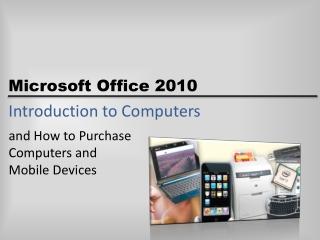
Introduction to Computers and How to Purchase Computers and Mobile Devices
What Is a Computer? • An electronic device, operating under the control of instructions stored in its own memory, that can: • Accept data (input) • Process the data according to specified rules (process) • Produce results (output) • Store the results (storage) for future use Microsoft Office 2010: Introduction to Computers
What Is a Computer? Microsoft Office 2010: Introduction to Computers
The Components of a Computer • The six primary components of a computer are input devices, the processor (control unit and arithmetic/logic unit), memory, output devices, storage devices, and communications devices • The processor, memory, and storage devices are housed in a box-like case called the system unit Microsoft Office 2010: Introduction to Computers
The Components of a Computer Microsoft Office 2010: Introduction to Computers
Personal Computers and Mobile Devices • A personal computer is a computer that can perform all of its input, processing, output, and storage activities by itself • A mobile device is a computing device small enough to hold in your hand Microsoft Office 2010: Introduction to Computers
Personal Computers and Mobile Devices • Desktop computer • Notebook computer • Laptop computer • Netbook • Tablet PC • Mobile devices • Smart phone • Portable media player • Digital camera Microsoft Office 2010: Introduction to Computers
Input Devices • An input device is any hardware component that allows you to enter data and instructions into a computer • A keyboard is an input device that contains keys users press to enter data and instructions into the computer • A stylus is a small metal or plastic device that looks like a tiny ink pen, but uses pressure instead of ink • A mouse is a pointing device that fits comfortably under the palm of your hand • Most notebook computers have a touchpad, a small, flat, rectangular pointing device Microsoft Office 2010: Introduction to Computers
Input Devices Microsoft Office 2010: Introduction to Computers
Input Devices • Other input for mobile devices Microsoft Office 2010: Introduction to Computers
System Unit • The system unit is a case that contains electronic components of the computer used to process data • The processor (CPU) interprets and carries out the basic instructions that operate a computer • Arithmetic/Logic Unit • Control Unit • Memory (RAM) consists of electronic components that store instructions waiting to be executed and data needed by those instructions Microsoft Office 2010: Introduction to Computers
System Unit Microsoft Office 2010: Introduction to Computers
Output Devices • Output devices are hardware components that convey information to one or more people • A printeris an output device that produces text and graphics on a physical medium such as paper • Ink-jet printer • Photo printer • Laser printer • Multifunction peripheral (all-in-one device) Microsoft Office 2010: Introduction to Computers
Output Devices Microsoft Office 2010: Introduction to Computers
Display Devices • A display device is an output device that visually conveys text, graphics, and video information • LCD monitors use a liquid crystal display to produce images on the screen Microsoft Office 2010: Introduction to Computers
Display Devices Microsoft Office 2010: Introduction to Computers
Storage Devices • A storage device is the computer hardware that records and/or retrieves items to and from storage media • A hard disk is a storage device that contains one or more inflexible, circular platters that use magnetic particles to store data, instructions, and information • Sectors • Tracks Microsoft Office 2010: Introduction to Computers
Storage Devices Microsoft Office 2010: Introduction to Computers
Storage Devices • An external hard disk is a separate freestanding hard disk that connects with a cable to a port on the system unit or communicates wirelessly • A removable hard disk is a hard disk that you insert and remove from a drive Microsoft Office 2010: Introduction to Computers
Storage Devices • Flash memory is a type of memory that can be erased electronically and rewritten • Solid state media • A solid state drive (SSD) is a storage device that typically uses flash memory to store data, instructions, and information Microsoft Office 2010: Introduction to Computers
Storage Devices • A memory card is a removable flash memory device, usually no bigger than 1.5 inches in height or width, that you insert and remove from a slot in a computer, mobile device, or card reader/writer Microsoft Office 2010: Introduction to Computers
Storage Devices • A USB flash drive, sometimes called a thumb drive, is a flash memory storage device that plugs into a USB port on a computer or mobile device • An ExpressCard module is a removable device that fits in an ExpressCard slot Microsoft Office 2010: Introduction to Computers
Storage Devices • An optical disc is a flat, round, portable metal disc with a plastic coating Microsoft Office 2010: Introduction to Computers
Storage Devices • Cloud storage is an Internet service that provides hard disk storage to computer users Microsoft Office 2010: Introduction to Computers
Communications Devices • A communications device is a hardware component that enables a computer to send (transmit) and receive data, instructions, and information to and from one or more computers or mobile devices • Transmission media Microsoft Office 2010: Introduction to Computers
Computer Software • Software, also called a program, consists of a series of related instructions, organized for a common purpose, that tells the computer what tasks to perform and how to perform them • Graphical user interface • Web application • System software consists of programs to control the operations of computer and its devices • Operating system • Utility program Microsoft Office 2010: Introduction to Computers
Computer Software Microsoft Office 2010: Introduction to Computers
Computer Software • Application software consists of programs designed to make users more productive and/or assist them with personal tasks • Word processing • Presentation • Spreadsheet • Database • E-mail Microsoft Office 2010: Introduction to Computers
Computer Software Microsoft Office 2010: Introduction to Computers
Networks and the Internet • A network is a collection of computers and devices connected together, often wirelessly, via communications devices and transmission media • Local area network • Wide area network Microsoft Office 2010: Introduction to Computers
Networks and the Internet • The Internet is a worldwide collection of networks that links millions of businesses, government agencies, educational institutions, and individuals • Internet service provider (ISP) • Online service provider (OSP) • Wireless Internet service provider (WISP) Microsoft Office 2010: Introduction to Computers
Networks and the Internet • The World Wide Web contains billions of documents called Web pages • Web page • Web site • Web browser • Web address • Hypertext transfer protocol Microsoft Office 2010: Introduction to Computers
Networks and the Internet • When you conduct business activities online, you are participating in electronic commerce, also known as e-commerce • Business to consumer (B2C) • Consumer to consumer (C2C) • Business to business (B2B) Microsoft Office 2010: Introduction to Computers
Searching the Web Microsoft Office 2010: Introduction to Computers
Computer Viruses and Other Malware • Computer virus • Worm • Trojan horse • Rootkit • An antivirus program protects a computer against viruses by identifying and removing any computer viruses found in memory, on storage media, or on incoming files Microsoft Office 2010: Introduction to Computers
Introduction to Computers Complete