First Principles Study of Surface Energetics and Chemisorption in ALD-Based Oxide Deposition
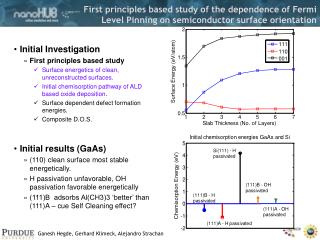
This study explores surface energetics of clean, unreconstructed semiconductor surfaces, focusing on the initial chemisorption pathways in atomic layer deposition (ALD) for oxide formation. We analyze defect formation energies dependent on surface orientation, with initial results highlighting the stability of the GaAs (110) clean surface. Our findings indicate that H-passivation is energetically unfavorable, while OH-passivation is favorable. Notably, (111)B surfaces exhibit superior adsorption of Al(CH3)3 compared to (111)A, suggesting implications for self-cleaning effects. We also examine Fermi level pinning based on surface orientation.

First Principles Study of Surface Energetics and Chemisorption in ALD-Based Oxide Deposition
E N D
Presentation Transcript
Initial Investigation First principles based study Surface energetics of clean, unreconstructed surfaces. Initial chemisorption pathway of ALD based oxide deposition. Surface dependent defect formation energies. Composite D.O.S. Initial results (GaAs) (110) clean surface most stable energetically. H passivation unfavorable, OH passivation favorable energetically (111)B adsorbs Al(CH3)3 ‘better’ than (111)A – cue Self Cleaning effect? First principles based study of the dependence of Fermi Level Pinning on semiconductor surface orientation