Genetic Organisation
In prokaryotes, transcription and translation occur in the same compartment (cytoplasm). The process is simultaneous, with short-lived mRNAs. Factors like sigma recognize promoters, and termination can be rho-dependent. Ribosomes bind to mRNA at specific sequences. Proteins are secreted using various pathways, repair systems are in place, and mutations occur randomly. Understand prokaryotic genetic and protein organization in depth.
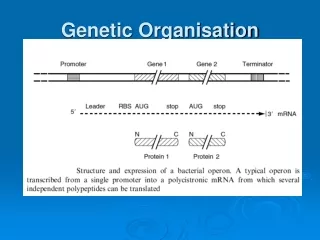

Genetic Organisation
E N D
Presentation Transcript
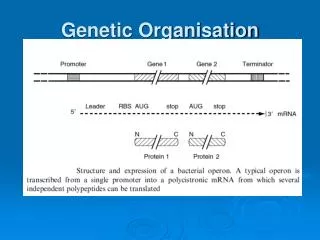
In Prokaryotes • Transcrition and translation occurs in same compartment (cytoplasm) • Simultaneous; m-RNAs are short-lived (afew minutes) • No splicing • M-RNA is not polyadenylated • No IRES in eukaryotes • No introns in prokayotes (except some bacteriophages)
5’-3’ direction Any strand of DNA can be transcribed No need for helicases, topoisomerases, primers RNA polymerase: 4 chains 2alpha, beta, Beta’ Promoter is recognised by the factor sigma Transcription
In some cases termination rho dependent factors, which are helicases • Rho utilisation site 80-100 bp upstream of actual terminator • In E. Coli other factors: tau, nus
70 s = 50 S and 30 S 50 S subunits: 23 S and 5 S RNA molecules 30 S subunits: 16 S RNA and 21 polypeptides rRNA binds to m-RNA at spesific sequences: Shine-Dalgerno sequence (RBS) partly complementary to the 3’ end of 16 S RNA In bacteria ribosomes
Secretion of the proteins • Many proteins exert their functions on the cell surface or in extracellular environement they should across the cytoplasmic membrane • GSP Sec dependent pathway • Proteins utlising GSP have a specific sequence at their N termini, which is cleaved during the transport
In Gram positive bacteria GSP is sufficient but ın Gram negative bacteria Proteins reach only to the periplasmic space
Gram negatives have addional mechanism: Sec dependent and Sec independent Sec dependent systems • Type II secretion system: A multiprotein complex transports proteins from the periplasmic space to the outside • Type V secretion system: The proteins have an additional sequence at the C terminus, forming pores in the outer membrane (aototransporters)
Sec independent systems • Types I, III and IV
Repair systems • Proof-reading • Miss-match repair: Methyle directed missmatch repair • Excision repair:uvrA, B and C endonucleases
SOS repair:ssDNA stimulates rec A • Rec A downregulates lex A whic repress SOS genes (18 genes) • Error prone DNA repairing system
MUTATION and VARIATION • BActerial populations are not homgeneous • Mutations occurr randomly (Luria-Delbruck experiment – fluctuation test, 1943)
Mutants • Auxotrophs: Biochemically different from the parent (prototroph) • Resistant: Antimicrobial resistance • Spontaneous mutations approx. 1 in 1 million
Mutagenes • UV-light (TT-dimers formations Mutations, replication errors)