Social and Knowledge Structures in a Note-based Document Sharing System
This paper examines the implicit organizational structures involved in note-taking, sharing, and retrieval within a collaborative environment, specifically through the NotePals system. It discusses concepts of centrality and prestige, drawing on past research to understand how relationships and active involvement influence note accessibility. The study highlights problems with limited search methods and restrictive organization while surveying user responses to investigate the prestige of different actors and contexts. Future work aims to enhance search capabilities and automate clustering based on author prestige and note relevance.

Social and Knowledge Structures in a Note-based Document Sharing System
E N D
Presentation Transcript
Social and Knowledge Structures in a Note-based Document Sharing System Jonathan Huang Human Centered Computing Dec. 6, 1999
Overview • Motivation • NotePals • Centrality & Prestige • Application to NotePals • Survey • Conclusion • Future Work
Motivation • Implicit organizational structures in the way we take, share, and retrieve notes • Centrality & Prestige • Collaborative filtering, clustering access, ranking
NotePals • Lightweight meeting support system • Digital Ink format • PDAs, Crosspads
Problems • Limited Search Methods • Restrictive Organization
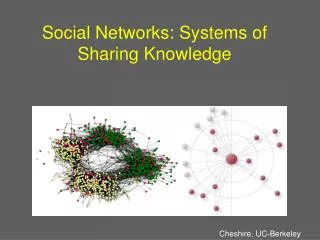
Social & Knowledge Structure • Centrality • Prominent actors are those that are extensively involved in relationships with other actors. • Knoke and Burt (1983) - those actors with the most access or most control or most active. • Freeman (1977, 1979, 1980a) advocated the use of centrality measures to understand group structure
Social & Knowledge Structure • Prestige • a.k.a. status by Moreno (1934) and others • exist in directional relations • attempt to quantify the rank that a particular actor has within a set of actors.
Applications to NotePals • Centrality • Number of notes • Clustering based on access • lots of access/query -> author has central role in note structure • Collaborative filtering • rank the usefulness of document
Applications to NotePals • Prestige • References within notes • Hand writing recognition • Assign status to users (background, experience) • levels of background categorization • multiple groups of practice
Survey • 15 responses • 9 grads, 6 undergrads • Prestige • Professor (9.33), TA (6.8), Research Community (6.33), friend/classmate (6) • Centrality • Lecture/class (9.63), Seminar (7.83), Project (7), Web (3.5)
Conclusion & Future Work • Centrality and Prestige exist in note-taking practices • Allow searches by author prestige and quantity of notes • Automated clustering of notes by subject/author • Infer authorities based on note access to find related work