
SlideServe
Menu
Préférences
© SlideServe · v2026

The FRAME Routine

agalia avatar
2 diapositives · 655 Views · Jul 25, 2014

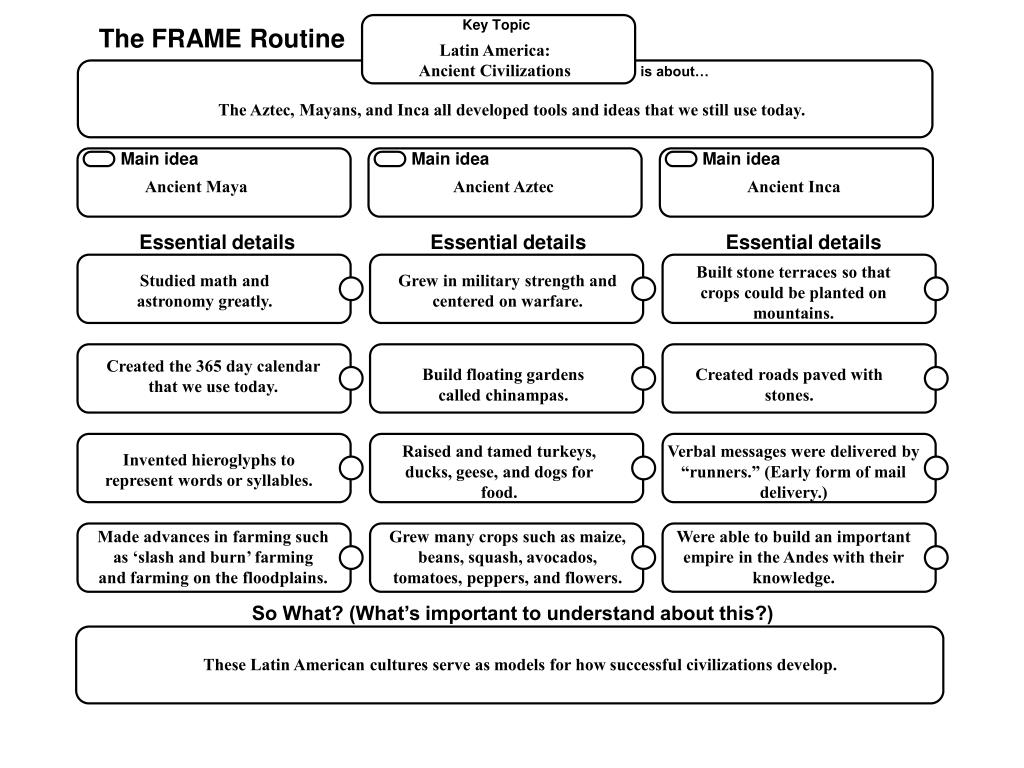
Key Topic. The FRAME Routine. is about…. Main idea. Main idea. Main idea. Essential details. Essential details. Essential details. So What? (What’s important to understand about this?). Latin America: Ancient Civilizations.
The FRAME Routine - slide 1
01 / 2The FRAME Routine
1 / 17

Télécharger la présentation

The FRAME Routine
Une image / un lien ci-dessous est fourni (tel quel) pour télécharger la présentation

Politique de téléchargement : le contenu du site vous est fourni TEL QUEL pour votre information et votre usage personnel ; il ne peut être vendu, concédé sous licence ni partagé sur d’autres sites sans l’accord de son auteur.Le contenu vous est fourni TEL QUEL, pour votre information et votre usage personnel uniquement. Téléchargez la présentation en cliquant sur ce lien. Lors du téléchargement, si vous ne parvenez pas à télécharger une présentation, l’éditeur a peut-être supprimé le fichier de son serveur.Pendant le téléchargement, si vous ne parvenez pas à obtenir une présentation, le fichier a peut-être été supprimé par l’éditeur.

F I N

Plus de contenu associé

Transcription de la présentation
  1. Key Topic The FRAME Routine is about… Main idea Main idea Main idea Essential details Essential details Essential details So What? (What’s important to understand about this?) Latin America: Ancient Civilizations The Aztec, Mayans, and Inca all developed tools and ideas that we still use today. Ancient Maya Ancient Aztec Ancient Inca Built stone terraces so that crops could be planted on mountains. Studied math and astronomy greatly. Grew in military strength and centered on warfare. Created the 365 day calendar that we use today. Build floating gardens called chinampas. Created roads paved with stones. Raised and tamed turkeys, ducks, geese, and dogs for food. Verbal messages were delivered by “runners.” (Early form of mail delivery.) Invented hieroglyphs to represent words or syllables. Made advances in farming such as ‘slash and burn’ farming and farming on the floodplains. Grew many crops such as maize, beans, squash, avocados, tomatoes, peppers, and flowers. Were able to build an important empire in the Andes with their knowledge. These Latin American cultures serve as models for how successful civilizations develop.

  2. Key Topic The FRAME Routine is about… Main idea Main idea Main idea Essential details So What? (What’s important to understand about this?) Latin America: PHYSICAL GEOGRAPHY Latin America is a vast land of varied geography united by a common language. Made up of several countries and continents Geography varies greatly from area to area Part of the Tropical Climate Zone Latin America includes Mexico, Central America, the Caribbean, and South America. The physical terrain of Mexico and Central America includes mountain ranges, deserts, forests, and volcanoes. The majority of Latin America lies in the Tropical Zone. This zone may be rainy or dry, but it is typically hot. As a part of the Tropical Zone, Latin America experiences El Niño every year. This brings heavy rains and often flooding to the area. Physical geography influences Latin America’s cultures, offering them both resources and obstacles.