
SlideServe
Menu
Préférences
© SlideServe · v2026

The FRAME Routine

gamada avatar
1 diapositives · 652 Views · Jul 15, 2014

The FRAME Routine. Key Topic. is about…. Main idea. Main idea. Main idea. Main idea. Main idea. Main idea. Main idea. Main idea. So What? (What’s important to understand about this?). Visual Images.
The FRAME Routine - slide 1
01 / 1The FRAME Routine
1 / 17

Télécharger la présentation

The FRAME Routine
Une image / un lien ci-dessous est fourni (tel quel) pour télécharger la présentation

Politique de téléchargement : le contenu du site vous est fourni TEL QUEL pour votre information et votre usage personnel ; il ne peut être vendu, concédé sous licence ni partagé sur d’autres sites sans l’accord de son auteur.Le contenu vous est fourni TEL QUEL, pour votre information et votre usage personnel uniquement. Téléchargez la présentation en cliquant sur ce lien. Lors du téléchargement, si vous ne parvenez pas à télécharger une présentation, l’éditeur a peut-être supprimé le fichier de son serveur.Pendant le téléchargement, si vous ne parvenez pas à obtenir une présentation, le fichier a peut-être été supprimé par l’éditeur.

F I N

Plus de contenu associé

Transcription de la présentation
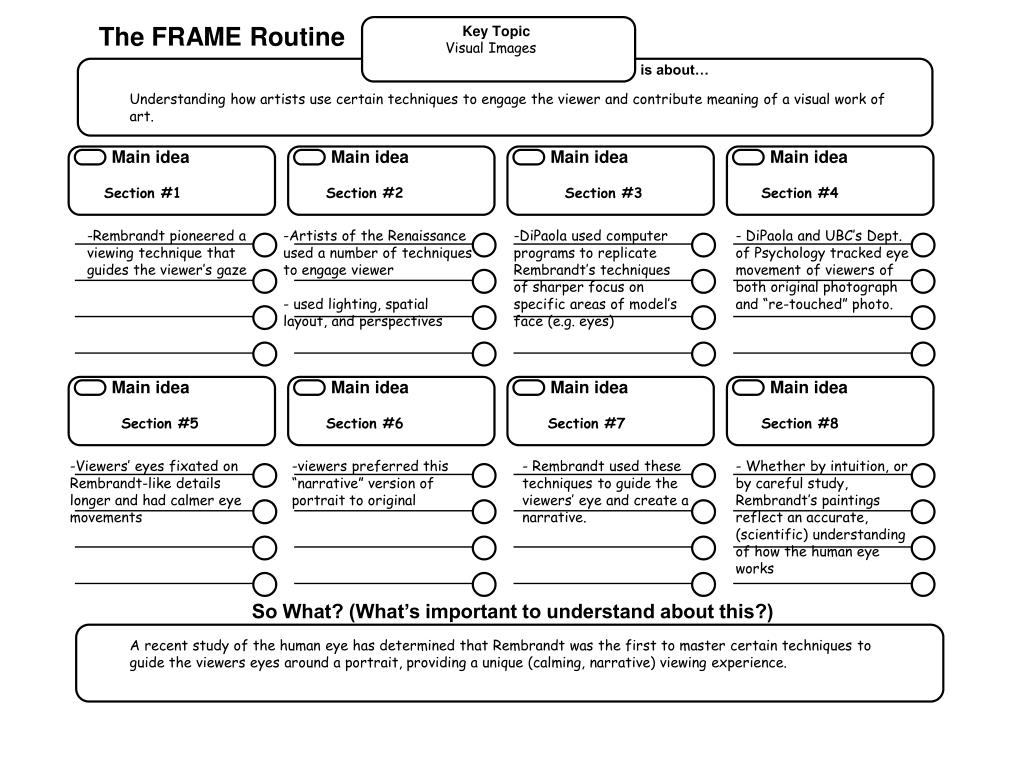
  1. The FRAME Routine Key Topic is about… Main idea Main idea Main idea Main idea Main idea Main idea Main idea Main idea So What? (What’s important to understand about this?) Visual Images Understanding how artists use certain techniques to engage the viewer and contribute meaning of a visual work of art. Section #1 Section #2 Section #3 Section #4 • Rembrandt pioneered a viewing technique that guides the viewer’s gaze • Artists of the Renaissance used a number of techniques to engage viewer • used lighting, spatial layout, and perspectives • DiPaola used computer programs to replicate Rembrandt’s techniques of sharper focus on specific areas of model’s face (e.g. eyes) - DiPaola and UBC’s Dept. of Psychology tracked eye movement of viewers of both original photograph and “re-touched” photo. Section #5 Section #6 Section #7 Section #8 • Viewers’ eyes fixated on Rembrandt-like details longer and had calmer eye movements • viewers preferred this “narrative” version of portrait to original - Rembrandt used these techniques to guide the viewers’ eye and create a narrative. - Whether by intuition, or by careful study, Rembrandt’s paintings reflect an accurate, (scientific) understanding of how the human eye works A recent study of the human eye has determined that Rembrandt was the first to master certain techniques to guide the viewers eyes around a portrait, providing a unique (calming, narrative) viewing experience.