Understanding Probabilities of Dependent and Independent Events
This section explores the key concepts of probability, focusing on both dependent and independent events. It distinguishes between theoretical and experimental probability, and addresses essential questions such as how to identify the nature of compound events. Probability is defined as a number between 0 and 1 that indicates the likelihood of an event's occurrence. Theoretical probability is calculated through the ratio of favorable outcomes to total outcomes, while experimental probability is determined through actual trials. The content also provides activities for finding the probability of compound events.

Understanding Probabilities of Dependent and Independent Events
E N D
Presentation Transcript
Probability 8.11 (A) – You will be expected to be able to find the probabilities of dependent and independent events.
Essential Questions • What’s the difference between theoretical and experimental probability? • How can you determine when compound events are independent and dependent?
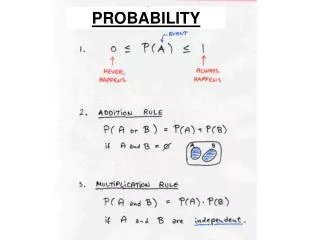
What do you know about probability? • Probability is a number from 0 to 1 that tells you how likely something is to happen. • Probability can have two approaches -experimental probability -theoretical probability
Theoretical vs. Experimental Theoretical Probability Experimental Probability The ratio of the number of times the event occurs to the total number of trials. P(E)= # of times event occurs Total # of outcomes • The likelihood that something will happen. P(T) = #of favorable outcomes Total # of outcomes
Compound Events How does this affect probability? • Compound probability is the probability that two or more events occur. • First, you must determine if the events are independent or dependent. • What is the probability of rolling an even number on the first dice and rolling a 3on the second dice? (ind. or dep.? Find probability)
Dependent vs. Independent Probability # of favorable___________# of possible Multiplication of two ratios More than one event