Download
1 / 14
140 likes | 275 Vues
This primer provides an overview of astronomical distances and the formation of star clusters, galaxies, and black holes. It discusses the differences between single stars, binary systems, and clusters like open and globular clusters, with examples such as M13 in Hercules and the Pleiades in Taurus. The guide also explores our Milky Way galaxy and its central black hole, Sgr A*, while highlighting other notable galaxies like M31, M81, and M82. For those fascinated by the cosmos, this content is invaluable for understanding our universe's structure.

E N D
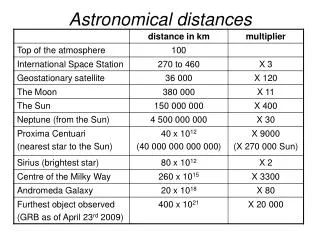
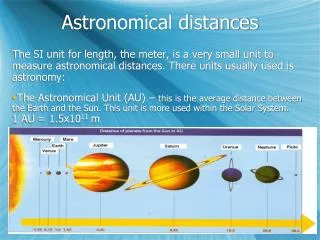
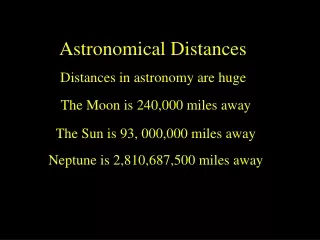
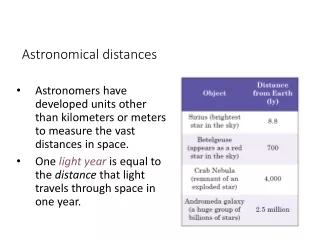
A quick Primer for Astronomical Distances • http://www.telescope.org/nuffield_21_sci/astrounits.htm • http://janus.astro.umd.edu/astro/distance/ • http://heasarc.nasa.gov/docs/cosmic/earth.html
Star Clusters, Galaxies, & Black Holes Life and Death in a Community of Stars
Stars do not occur in space at completely arbitrary places. Some, such as the Sun, are single (field star), but others are members of pairs or form multiple-star systems. Still others form clusters of various types, and size. All of them are condensed from clouds of gas and dust.
Star Clusters Open Cluster Globular Cluster Contain old stars Tight mass due to stars being drawn by each others’ gravity. Example: M13 in Hercules Contain young stars Often with nebulous gases Example: Pleiades in Taurus
Milky Way Q & A http://www.universetoday.com/21563/milky-way/
For more info… http://www.enchantedlearning.com/subjects/astronomy/stars/constellations.shtml