Distances to Astronomical Objects
This overview delves into the vastness of the Universe, highlighting key concepts such as the distances to astronomical objects, the motion of galaxies, and the implications of Hubble's Law. It discusses the significance of the Big Bang model, including the early hot universe and the cosmic microwave background radiation as observational evidence. Furthermore, the text examines the expansion of the Universe over time, the role of dark energy, and the changing rate of expansion as measured by advanced telescopic observations, providing insights into the Universe's age and structure.

Distances to Astronomical Objects
E N D
Presentation Transcript
Recap • The Universe of Galaxies • Motions of galaxies: radial and transverse motion • Recession of galaxies: Hubble’s law • velocity of galaxies is proportional to their distance • Expansion of the Universe • Observe expansion only on largest scales • Models for an expanding Universe • Big Bang model: Universe has always been expanding • Implication: early Universe was different and HOT • Prediction: Early Universe glows • Observation: Microwave background radiation!
Big Bang test • Observation: is the prediction observed? • Yes! The cosmic microwave background • Do other models make this same prediction? All that’s required is that Universe has always been expanding, but not that the rate has always been the same • There are other predictions of the Big Bang theory that are also verified by observation, so it is very widely accepted (although, of course, not by every single person!) • Abundances of light elements • Large scale structure as observed The Cosmic Microwave Background !!
Theoretical support for Big Bang • Totally apart from observations of galaxies (in fact before radial motions were observed), Einstein developed a theory of gravity called general relativity • When he applied it to the Universe as a whole, he found that in the simplest form of his theory, that the Universe couldn’t be “static”, it had to be expanding or contracting • He thought this was unlikely, so he added an arbitrary term to his equations to get rid of this feature. After expansion was discovered to exist, he called this his “greatest mistake” • However, it now turns out that maybe it wasn’t…. • In any case, Big Bang model has theoretical support as well as observational
Past and future • Microwave background strongly suggests that universe has been expanding for a long time • But has it been expanding at the same speed? • Gravity is a force that pulls things together. Even though it’s not strong enough over large scales to counteract expansion of Universe, it was expected that it would slow it down over time: deceleration • Can we observe change of expansion rate over time? • Telescopes are time machines! • What do we observe? Acceleration! Expansion is speeding up! • Dark energy! • Measuring changing rate of expansion, allows us, with theoretical understanding, to determine the amount of time since the Big Bang, i.e. the age of the Universe, which is currently thought to be 13.8 billion years!
Recap: Overview of the Universe • Where do we live? • Earth • Solar System • Milky Way galaxy • Universe • Perspective • Is there a center of the Solar System? Do we live there? • Is there a center of the Milky Way? Do we live there? • Is there a center of the Universe?
Perspective • Some video resources • Powers of ten • AMNH `Simulated Universe • How large is the Universe
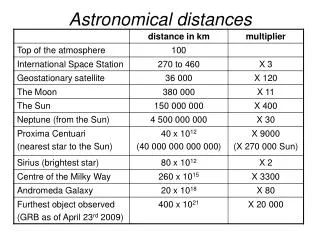
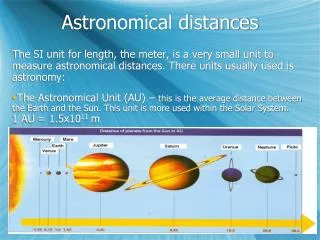
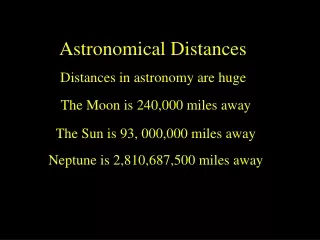
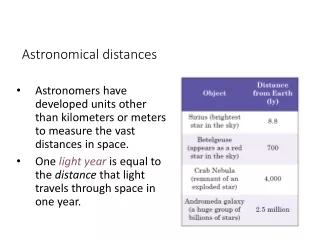
Recurring themes • We don’t live in the center of anything • Distances between astronomical objects are LARGE, generally much larger than the objects themselves: universe is mostly empty • But how do we measure such large distances?