Download
1 / 24
310 likes | 831 Vues
This document explores the concept of the canonical ensemble, detailing the equilibrium between a system and a heat reservoir. It covers the physical significance of various statistical quantities, alternative expressions for the partition function, and energy fluctuations. The discussion includes the classical systems, theorems like equipartition and virial, and specific case studies such as harmonic oscillators and the statistics of paramagnetism. The implications for thermodynamics, particularly regarding negative temperatures, are also examined along with the advantages of using the canonical ensemble over the microcanonical ensemble.

E N D
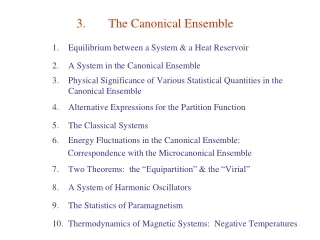
3. The Canonical Ensemble Equilibrium between a System & a Heat Reservoir A System in the Canonical Ensemble Physical Significance of Various Statistical Quantities in the Canonical Ensemble Alternative Expressions for the Partition Function The Classical Systems Energy Fluctuations in the Canonical Ensemble: Correspondence with the Microcanonical Ensemble Two Theorems: the “Equipartition” & the “Virial” A System of Harmonic Oscillators The Statistics of Paramagnetism Thermodynamics of Magnetic Systems: Negative Temperatures
Reasons for dropping the microcanonical ensemble: • Mathematical: Counting states of given E is difficult. • Physical: Experiments are seldom done at fixed E. Canonical ensemble : System at constant T through contact with a heat reservoir. • Let r be the label of the microstates of the system. • Probablity Pr( Er) can be calculated in 2 ways: • Pr # of compatible states in reservoir. • Pr~ distribution of states in energy sharing ensemble.
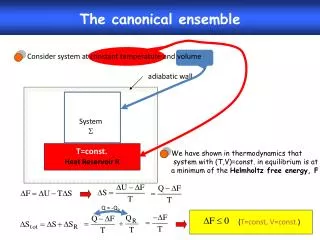
3.1. Equilibrium between a System & a Heat Reservoir Isolated composite system A(0) = ( System of interest A ) + ( Heat reservoir A ) Heat reservoir : , T = const. Let r be the label of the microstates of A. with Probability of A in state r is
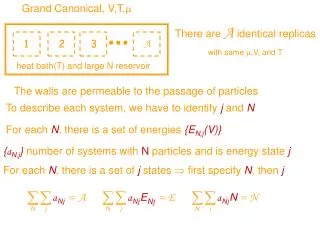
3.2. A System in the Canonical Ensemble Consider an ensemble of N identical systems sharing a total energy E. Let nr = number of systems having energy Er ( r = 0,1,2,... ). = average energy per system Number of distinct configurations for a given E is Equal a priori probabilities (X) means sum includes only terms that satisfy constraint on X. { nr* } =most probable distribution
Method of Most Probable Values To maximize lnW subjected to constraints is equivalent to minimize, without constraint , are Lagrange multipliers
with Let and set Same as sec 3.1 E.g.
Method of Mean Values ~ means “depend on {r} ”. Let Thus Constraints: Note: r in { nr } is a dummy variable that runs from 0 to , including s.
Method of Steepest Descent ( Saddle Point ) is difficult to evaluate due to the energy constraint. Its asymptotic value ( N ) can be evaluate by the MSD. Define the generating function Binomial theorem U removes the energy constraint. where
NU = integers = coefficient of zN U in power expansion of . This is the case if all Er , except the ground state E0= 0, are integer multiples of a basic unit. analytic for |z| < R C : |z| < R ( For { r~ 1 }, sharp min at z = x0 ) Let
N >>1 Fo z real, has sharp min at x0 max along ( i y )-axis For z complex : x0 is a saddle point of .
MSD: On C, integrand has sharp max near x0 . Gaussian dies quickly
C.f. so that With { r = 1 } :
Fluctuations where
3.3. Physical Significance of Various Statistical Quantities in the Canonical Ensemble
3.6. Energy Fluctuations in the Canonical Ensemble: Correspondence with the Microcanonical Ensemble
3.10. Thermodynamics of Magnetic Systems: Negative Temperatures