Download
1 / 4
40 likes | 153 Vues
This work delves into ancient Western and Hindu perspectives on the mind-body relationship. It examines materialism, dualism, and the notions of an immortal soul through the thoughts of philosophers like Democritus, Lucretius, Plato, and Aristotle. The Hindu concept of the self is contrasted with Western interpretations, discussing the nature of reality as presented by thinkers like Sankara and Ramanuja. Additionally, modern solutions to mind-body dualism by Descartes, Spinoza, and Leibniz are explored, highlighting the ongoing philosophical debate surrounding consciousness and existence.

E N D
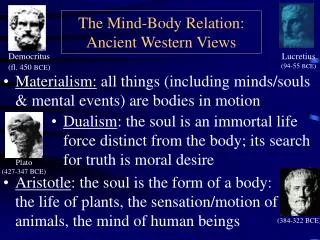
The Mind-Body Relation: Ancient Western Views Democritus (fl. 450BCE) Lucretius (94-55 BCE) • Materialism: all things (including minds/souls & mental events) are bodies in motion • Dualism: the soul is an immortal life force distinct from the body; its search for truth is moral desire Plato (427-347 BCE) • Aristotle: the soul is the form of a body: the life of plants, the sensation/motion of animals, the mind of human beings (384-322 BCE)
The Hindu Self • The experienced part of person (the conscious self and body) differs from the all-pervading divine Self, which is not known or reasoned to • Sankara: The phenomenal world (including selves) does not exist (788-820) • Ramanuja: The phenomenal self is a modification of the inner self (God/Brahman) (1077-1157)
Mind-Body Dualism (1596-1650) (1637-78) • René Descartes: human beings are composed of a material body and an immaterial mind that are distinct but linked through the pineal gland • Problem: Interaction. Proposed solutions: • Anne Conway: bodies are not really different from souls; both express different degrees of how reality is organized and expressed
Other Proposed Solutions to Mind-Body Dualism (1646-1716) (1632-77) • Baruch Spinoza: mind and body are simply different ways in which God is expressed (dual aspect monism) • G. W. Leibniz: mental and physical events happen independently of one another but are harmonized by God (parallelism)