Understanding Electricity: Definitions, Measurement, and Ohm's Law Explained
This guide covers the fundamentals of electricity, including definitions, working principles, and measurements. It explains the flow of electrons in conductive materials like copper wire, the concept of electric current (I), and how it is measured. The relationship between current and potential difference (voltage) is introduced through Ohm's Law, detailing how to measure and calculate these values in both series and parallel connections. High and low resistance scenarios are also discussed. Ideal for students and anyone interested in understanding basic electrical concepts.

Understanding Electricity: Definitions, Measurement, and Ohm's Law Explained
E N D
Presentation Transcript
Current electricityThe basics Definitions, working and measurements
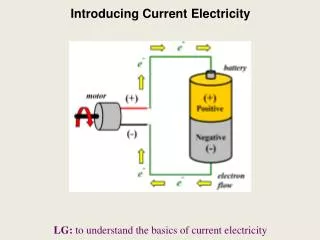
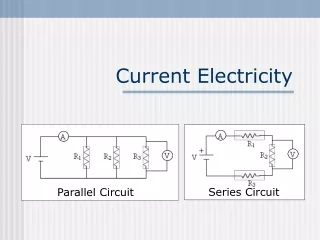
Atoms in copper wire have loose valence e-: sea of delocalised electrons R V Simple circuit Enlarged piece of wire flow of charges (electrons: e-) Electric current: e- • Measures current strength (I) If 5e- flow into R, 5 e- come out the other side (they have less energy) A • Rate of flow of charge (Q) e- Q (Q = I t) • I = Δt e- e- LOW energy HIGH energy (1A=1Cs-1) e- e- • Connected in series(just counting charges in certain time) • Low resistance (charges are to flow easily) When battery connected: e- flows in one direction (- to +) • Measures potentialdifference(pd) in volts (V) • Measures (electrical) potential (energy) difference in volts (V) • Thus energy per charge transferred between two points W (1V=1JC-1) V = Q • Connected in parallel • High resistance (take HIGH reading of energy and LOW reading of energy and subtract to give difference). No current flows through!
Atoms in copper wire have loose valence e-: sea of delocalised electrons R V Simple circuit Enlarged piece of wire flow of charges (electrons: e-) Electric current: e- • Measures current strength (I) If 5e- flow into R, 5 e- come out the other side (they just have less energy) A • Rate of flow of charge (Q) e- Q (Q = I t) • I = Δt e- (1A=1Cs-1) e- LOW energy HIGH energy • Connected in series(just counting charges in certain time) e- e- • Low resistance (charges are to flow easily) When battery connected: e- flows in one direction (- to +) • Measures potentialdifference(pd) in volts (V) • Thus energy per charge transferred between two points W (1V=1J C-1) V = Q • Connected in parallel • High resistance (take HIGH reading of energy and LOW reading of energy and subtract to give difference). No current flows through!
Ohm’s Law The relationship between pd and I is established There is a ……….. ………….. between potential difference and current strength at constant temperature
A R V Ohm’s Law The relationship between pd and I is investigated. Set up a table to take readings
Current strenght controlled by number of cells or a reostat (variable resistor) Ohm’s law
A R V Ohm’s Law cnt. proportionality direct Ohm’s law: There is a ……….. …………………. between potential difference and current strength at constant temperature (ohmic relationship) If temperature not constant – non-ohmic relationship (not straight line)
Non-Ohmic Conductors (or resistors) not adhering to Ohm’s law are non-ohmic conductors