Rhombuses, Rectangles, and Squares
This section explores the key properties and theorems related to rhombuses, rectangles, and squares, providing a solid foundation in quadrilateral geometry. It covers definitions of these shapes, including conditions that define a rhombus and rectangle, as well as their interrelations. Examples illustrate theorems such as the roles of diagonals in determining the types of quadrilaterals. Practice problems reinforce learning through application. This comprehensive overview aids in distinguishing and understanding these fundamental geometric figures.

Rhombuses, Rectangles, and Squares
E N D
Presentation Transcript
Rhombuses, Rectangles, and Squares Section 8.4
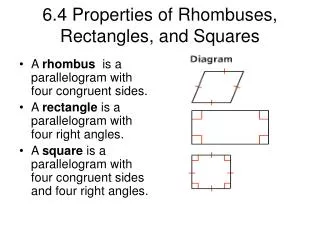
Rhombus Corollary • A quadrilateral is a rhombus if and only if it has four congruent sides.
Theorem • A parallelogram is a rhombus if and only if its diagonals are perpendicular.
Theorem • A parallelogram is a rhombus if and only if each diagonal bisects a pair of opposite angles.
Example:For any rhombus QRST, decide whether the statement is always or sometimes true.
Rectangle Corollary • A quadrilateral is a rectangle if and only if it has four right angles.
Theorem • A parallelogram is a rectangle if and only if its diagonals are congruent.
Example:For any rectangle ABCD, decide whether the statement is always or sometimes true.
Square Corollary • A quadrilateral is a square if and only if it is a rhombus and a rectangle.
Practice • p. 537: 3-24, 26-29