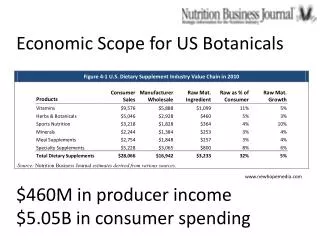
Economic Scope for US Botanicals
60 likes | 188 Vues
The U.S. botanical industry is projected to grow significantly, accumulating $596M in producer income and $5.89B in consumer spending by 2017. However, climate change poses risks as it may disrupt traditional growth patterns, impacting when herbs emerge and their resilience. Research highlights the need for predictive tools to assist growers and buyers in managing these changes effectively. Collaborative efforts are essential, focusing on identifying region-specific climate indicators among wild medicinal plants and translating climate dynamics into relevant cultural and health implications for stakeholders.


Economic Scope for US Botanicals
E N D
Presentation Transcript
Economic Scope for US Botanicals www.newhopemedia.com $460M in producer income $5.05B in consumer spending
Economic Scope for US Botanicals www.newhopemedia.com NBJ projects growth by 2017 to $596M in producer income $5.89B in consumer spending
Research on climate effects on herbs is emerging “Climate change, however, may alter weather patterns such that the environmental cues signaling spring emergence no longer coincide with periods of low frost risk.” S. Souther & J.B. McGraw, WVU PopulEcol (2011) 53:119-129
Efforts to model under-story herb impacts began 10 years ago. Canadian Journal of Forest Research, 2002, 32(10): 1753-1762
Botanical industry needs of NCDC • Predictive visualization tools enabling growers to adjust species mixes and buyers to better allocate risk geographically • Collaborate with BCGR and others to determine bioregional climate indicator species among wild medicinal plants • Translate complex climate change dynamics to human cultural and health impacts that affected industry sectors can grasp