Estimating Pi Through Buffon's Needle: Precision and Convergence Analysis
This analysis explores the probabilistic method of estimating π using Buffon's Needle experiment. We uncover how the expected precision improves with increased iterations, where the error is inversely proportional to the square root of the work done—requiring significant effort for incremental accuracy. By evaluating the probability of a needle crossing a crack, we derive a mathematical framework for estimating π and determine how many trials are necessary to achieve desired precision levels. The study also includes convergence analysis and implications for practical simulations.

Estimating Pi Through Buffon's Needle: Precision and Convergence Analysis
E N D
Presentation Transcript
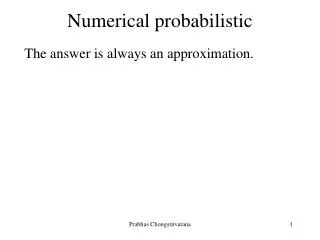
Numerical probabilistic The answer is always an approximation. Prabhas Chongstitvatana
The expected precision improves given more time. The answer is always an approximation. The expected precision improves given more time. Prabhas Chongstitvatana
The answer is always an approximation. The expected precision improves given more time. The error is inverse proportion to the square root of the amount of work. (100 times more work to obtain one additional digit of precision) Example : use in simulation Prabhas Chongstitvatana
Buffon’s needle 18th century, George Louis Leclerc, compte de Buffon. Probability that a needle will fall across a crack is 1/pi (each drop is independent to the others) Plank width = w Needle length L = w/2 Prabhas Chongstitvatana
Approximate pi : n/k as an estimator of pi Approximate w : w >= L , w is estimated by Prabhas Chongstitvatana
How fast this ‘algorithm’ converge? Convergence analysis Estimate pi : Xi each needle Xi =1 if i-th needle fall across a crack, 0 otherwise. Prabhas Chongstitvatana
X estimate of 1/pi after dropping n needles. Prabhas Chongstitvatana
X is normal distributed Prabhas Chongstitvatana
X is normal distributed Prabhas Chongstitvatana
We want to estimate pi not 1/pi when With n needles, estimate pi will have less precision than estimate 1/pi by one digit. Prabhas Chongstitvatana
Given n , the value of pi is between and with probability at least p Prabhas Chongstitvatana
Given n , the value of pi is between and Example : How many n to estimate pi within 0.01 of the correct value with the confidence 99% ? precision 0.001 (one more digit than estimate 1/pi) n >1.44 million Prabhas Chongstitvatana