Understanding Acids and Bases: Characteristics, Reactions, and pH Calculations
120 likes | 242 Vues
This comprehensive guide explores the fundamental characteristics of acids and bases, including their sour and bitter tastes, pH levels, and chemical formulas. Learn about key definitions, such as Arrhenius and Bronsted-Lowrey acids/bases and the concept of conjugate pairs. The guide covers essential reactions, including strong and weak acid/base dissociations, neutralization reactions, and the important pH scale. Additionally, discover the principles of reaction equilibrium, Le Chatelier's principle, and their implications in chemical reactions and titrations for measuring unknown concentrations.


Understanding Acids and Bases: Characteristics, Reactions, and pH Calculations
E N D
Presentation Transcript
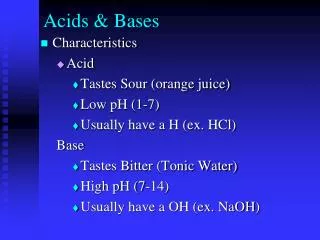
Acids & Bases • Characteristics • Acid • Tastes Sour (orange juice) • Low pH (1-7) • Usually have a H (ex. HCl) Base • Tastes Bitter (Tonic Water) • High pH (7-14) • Usually have a OH (ex. NaOH)
Definitions of acids/bases • Arrhenius Acid/Base (oldest one) • Gives up Hydronium/Gives up Hydroxide • Bronsted-Lowrey Acid/Base (more modern) • Gives up proton/Accepts proton
Conjugate Base Acid Conjugate Acid Base Parts of Reactions • Remember, Acids give up protons and Bases take ‘em! • HF + H2O H3O+ + F-
Acid Dissociations • Strong Acid + Water • When strong acids (HCl, HI, HBr, HNO3, HClO4 & H2SO4) are added to water they dissociate completely making hydronium and the anion of the acid. • HCl + H2O H3O+ + Cl- • Weak Acid + Water • When a weak acid is added to water, only a small portion of it dissociates (double arrow) making hydronium and the anion of the acid. • HF + H2O H3O+ + F-
Base Dissociations • Strong/Weak Bases • When a strong base (OH’s of 1st Column and Ca2+, Sr2+ & Ba2+) or weak base that is a hydroxide is added to water it breaks apart. Since the water does not actually change in the reaction, it is put over the arrow. • NaOH --> Na+ + OH- • Be(OH)2 --> Be2+ + 2OH-
Acid + Base • When an acid reacts with a base, salt and water are produced. The acid and base neutralize each other and it doesn’t matter if they are strong or weak! • HCl + NaOH NaCl + H2O • This is called a neutralization reaction
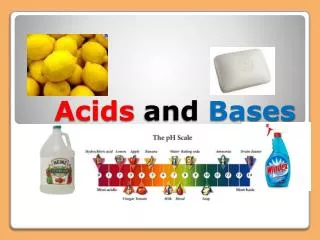
[H3O+] The pH Scale [H3O+] = [OH-] [OH-]
Calculate the pH's of strong acids from Molarity of Strong Acids. • [H+] = 1 x 10⁻⁷ M • [OH-] = 1x 10⁻⁷ M So what is the pH of distilled water?
Titrations • This is a lab technique that uses neutralization math that enables the user to find the pH of an unknown acid or base.
Le Chatlier’s Principle… • This principle says that for any change you make to a system at equilibrium, the system will shift to “undo” that change. • PCl5 (g) PCl3 (g) + Cl2 (g) • This reaction is endothermic… • Which way will the reaction shift if • Cl2 (g) is added? • Pressure is increased? • Reaction vessel is cooled down? • PCl3 is removed as it is formed?
Another Problem… • C (s) + H2O (g) CO (g) + H2 (g) • Reaction is Endothermic… • Which way will the reaction shift if • The reaction vessel is heated up? • Pressure is decreased? • More solid carbon is added? • Carbon monoxide is taken out?