Download
1 / 28
280 likes | 439 Vues
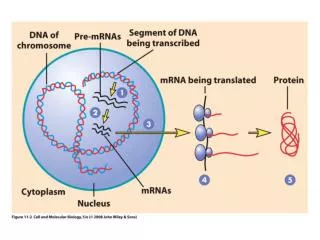
This overview explores the critical processes of transcription and translation in molecular biology. Transcription is the precise copying of DNA information into RNA, while translation is the conversion of that RNA information into proteins. The significance of codons, transfer RNAs (tRNA), and ribosomal mechanisms are discussed, detailing how genetic codes are interpreted and how proteins are synthesized accurately. Understanding these processes is vital for grasping the fundamentals of genetic expression and regulation.

E N D
Definitions • tran·scrip·tion (noun): the act of making an exact copy of a document. • Example: the very old method for making a copy of a book by hand. • trans·la·tion (noun): the rendering of the meaning of something into a different language. • Example: translating Leo Tolstoy’s novel “War and Peace” from Russian (the original) into English.
Translation • The synthesis of a protein polymer from a RNA template • The ribosome translates the chemical language of nucleic acids to amino acids • Provides a control point for regulation of gene expression • Amplification step (can make many protein copies)
Translation • There must be a nucleic acid code for amino acid sequences • 4 different nucleic acid bases, 20 different amino acids • PLUS, need information about where to START and where to STOP translating • Possible CODON sizes: • 1 base 41 = 4 not big enough • 2 bases 42 = 16 not big enough • 3 bases 43 = 64 THIS WOULD WORK • The code could be overlapping or NONOVERLAPPING • Nonoverlapping is less sensitive to mutation
Translation • Codons are nonoverlapping 3 nucleotide units • START = AUG (Methionine) • STOP = UGA, UAG, UAA (does NOT also encode an amino acid) • 61 of 64 codons are left for amino acids • There are only 20 amino acids • The code is “degenerate” with several codons per amino acid • CUN = Leucine • UCN = Serine • CCN = Proline • ACN = Threonine (ACA, ACG, ACC, ACU) (Where N = A, G, C or U) **Note, much of the degeneracy is in the 3rd position of the codon**
Transfer RNAs (tRNA) • Bridge between nucleic acid and amino acid languages • 73 - 93 nts long • Several modified bases (e.g. pseudouridine, etc) • Complementary regions base pair to form cloverleaf-like structure • Packs further to look like: • Amino acid attached to 3’-OH via ester linkage • Anticodon loop basepairs with mRNA codon
Transfer RNAs (tRNA) • Degeneracy of code • Lots of tRNA genes • 1 tRNA can recognize > 1 codon • Strict base pair rules for codon position 1 and 2 • “wobble” in position 3 • Non Watson-Crick pairing e.g. G:U pairing
Transfer RNAs (tRNA) • Examples of tRNAs tolerating G:U pairs in codon position 3
Charging tRNAs • Accuracy for protein synthesis is primarily from the accuracy of attaching the correct amino acid to the correct tRNA • 20 AminoacyltRNAsynthetase enzymes • 1 enzyme for each amino acid • 1 enzyme can recognize >1 tRNA • Specificity from interactions with acceptor and anticodon arms of tRNA
Charging tRNAs and proofreading • tRNAsynthetase enzymes can proofread • Can hydrolyze wrong amino acid from tRNA
The ribosome • Large RNA-Protein complex • Large ribosomal subunit (60S) • Small ribosomal subunit (40S) • Steps in translation: INITIATION • Bind mRNA, find start ELONGATION • Find next amino acid, add it TERMINATION • Recognize stop, and release
Translation mechanism: bacteria • INITIATION • Small subunit binds “Shine-Dalgarno” sequence in mRNA 5’-AGGAGG-3’ DNA: 5’-…TATAAT nnnnAnnnn AGGAGG nnnnn ATG…-3’ -10 +1 mRNA: 5’-A nnnn AGGAGG nnnnn AUG…-3’
Translation mechanism: bacteria • INITIATION • Small subunit binds Shine-Dalgarno sequence in mRNA to locate AUG • INITIATION FACTORS 1) IF1, IF2, IF3 • IF2 binds GTP
Translation mechanism: bacteria • INITIATION • Small subunit binds Shine-Dalgarno sequence in mRNA to locate AUG • INITIATION FACTORS 1) IF1, IF2, IF3 • IF2 binds GTP 2) IF2 binds initiating tRNA-Met
Translation mechanism: bacteria • INITIATION • Small subunit binds Shine-Dalgarno sequence in mRNA to locate AUG • INITIATION FACTORS 1) IF1, IF2, IF3 • IF2 binds GTP 2) IF2 binds initiating tRNA-Met 3) Recruit large subunit, release IF1, IF3 • If codon-anticodon interaction is correct, IF2 hydrolyzes GTP and leaves
Translation mechanism: eukaryotes • INITIATION • A pre-formed eIF1, 2, 3 + Small subunit complex binds 5’-CAP region • eIF4 and other factors are involved in sensing additional features of mRNA • 5’-CAP structure • 3’-end polyA tail • Complex SCANS5’--> 3’ for the consensus sequence 5’-CCACCAUG-3’ start codon
Translation mechanism: bacteria • ELONGATION • After large subunit bound, 3 sites are present in ribosome • Aminoacyl (A) site • Peptidyl (P) site • Exit (E) site • tRNA-MET in P site 1) EF-Tu + GTP + Phe-tRNA bind in A site • If codon-anticodon interaction is proper, hydrolyze GTP --> GDP, release EF-Tu
Translation mechanism: bacteria • ELONGATION • If codon-anticodon interaction is proper, hydrolyze GTP --> GDP, release EF-Tu 2) Peptidyltransferase enzyme catalyzes bond formation • large subunit of Ribosome RNA is a Ribozyme! • Met is now attached at the “A” site: Met-Phe-tRNA
Translation mechanism: bacteria • ELONGATION • Whole ribosome must be translocated 3 nts downstream on mRNA 3) EF-G hydrolyzes GTP for translocation reaction • tRNA in P site is now in E • Met-Phe-tRNA is now in P • Repeat ELONGATION cycle until a stop codon is reached
Translation mechanism: bacteria • ELONGATION • Repeat ELONGATION cycle until a stop codon is reached • EF-Tu + GTP + Ser-tRNA --> EF-Tu + GDP (note exit of tRNA from E site) • Peptidyltransferase activity would yield Met-Phe-Ser-tRNA in A site • And so on…
Translation mechanism: bacteria • TERMINATION • Stop codons are not recognized by any wildtypetRNAs • Three Release Factor proteins • RF1 • RF2 • RF3 • Enter A site and trigger hydrolysis of Met-Phe-Ser from tRNA • Large and small subunits dissociate from mRNA template U A A
Polyribosomes • mRNAs can be translated by multiple ribosomes at same time • Amplification step in gene expression
Coupled TXN & TLN: bacteria • A gene can be transcribed and translation of it can start before TXN is finished
Frameshift mutations 5’-GCCUCAGGAACCACC AUGCUAGCUUGCUGAAAUAAAAAAAAAAA-3’ TLN: M L A C *(stop) • Consider the following mRNA sequence • Frameshiftmutations insert or delete one or more bases into an Open Reading Frame (ORF) • Insert one base • Delete one base 5’-GCCUCAGGAACCACC AUGCUCAGCUUGCUGAAA UAA AAAAAAAAA TLN: M L S L L K *(stop) 5’-GCCUCAGGAACCACC AUGUAGCUUGCUGAAAUAAAAAAAAAAA-3’ TLN: M *(stop)
Nonsense mutations & nonsense mediated decay 5’-GCCUCAGGAACCACC AUGCUAUGGUGCUGAAAUAAAAAAAAAAA-3’ TLN: M L W C *(stop) • Consider the following mRNA sequence • Nonsense mutations change an amino acid codon to a stop codon • If this mutation is in any exon other than the last one, • Nonsense mediated decay (NMD) will block translation of it 5’-GCCUCAGGAACCACC AUGCUAUGAUGCUGAAAUAAAAAAAAAAA-3’ TLN: M L *(stop)
Nonsense mutations & nonsense mediated decay • Exon-Junction Complex (EJC) proteins are deposited on transcripts ~20 nts upstream of new Exon-Exon junctions • Ribosome knocks them off during TLN • If ribosome doesn’t knock them off, transcript is destroyed • Wildtype mRNA: • Nonsense mutation mRNA: • EJC that is not removed generates a signal targeting mRNA for destruction EJC EJC EJC X EJC EJC EJC X X