Understanding the Types of Chemical Reactions for Better Learning
100 likes | 224 Vues
This guide breaks down the various types of chemical reactions, including synthesis, decomposition, single displacement, double displacement, exothermic, endothermic, and combustion reactions. Each type is explained with simple examples and analogies to enhance understanding. You will learn how substances interact to form new compounds and how energy changes during these processes. This structured format is designed to aid in memorization and comprehension of chemical reactions for students and enthusiasts alike.


Understanding the Types of Chemical Reactions for Better Learning
E N D
Presentation Transcript
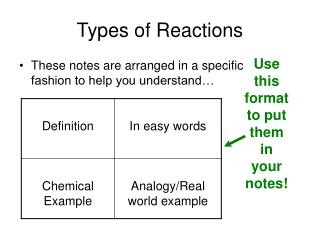
Types of Reactions Use this format to put them in your notes! • These notes are arranged in a specific fashion to help you understand…
Synthesis: 2 or more simple substances combine to form a more complex substance 2 small things form one big thing 2H2 + O2 2H2O Quarterback + Wide Receiver Complete Pass Good Food + Me A Happy Person
Decomposition: A more complex substance breaks down into its more simple parts Something big breaks down into 2 small things 2H2O 2H2 + O2 GloveBall Glove + Ball Completed Puzzle Puzzle Piece + Puzzle Piece
Single Displacement: A single uncombined element replaces another in a compound A single & a pair on one side switch places to a new single & a new pair Zn + 2HCl ZnCl2 + H2 DogBone + Steak DogSteak + Bone CatMouse + Catnip CatCatnip + Mouse
Double Displacement Reaction: Reaction parts of 2 compounds switch places to form 2 new compounds 2 more complex substances break apart and combine in a different way to form 2 new substances Ag(NO3) + NaCl AgCl + Na(NO3) Boy1Girl1 +Boy2Girl2 Boy1Girl2 + Boy2Girl1 QBackFootbal +PitcherBaseball QbackBaseball+PitcherFootball
Exothermic: A chemical reaction in which energy is released from the reactants; Temperature warms; Energy is on the product side of the reaction A reaction where heat is released into the environment Mg + 2H2O Mg(OH)2 + H2 + Heat Hand Warmers Thermal Back Stickers + =
Endothermic: a chemical reaction in which energy is absorbed by the reactants; temperature of the surroundings decreases; Energy will be on the reactant side A reaction where heat is sucked into the objects (NH4)(NO3) + H2O+Heat NH4 + NO3 Ice Pack + =
Combustion: All substances in a compound are combined with oxygen, which then produces carbon dioxide and water; heat is produced A reaction where burning is produced CH4 + 2O2 CO2 + 2H2O + Heat Gas burned in cars Gas burned in heating units + = O2