Download
1 / 5
50 likes | 228 Vues
This guide provides a comprehensive overview of the various types of chemical reactions including synthesis, decomposition, and replacement. Synthesis reactions involve two or more reactants forming a single product, while decomposition reactions break down a compound into simpler substances, often through heating. Replacement reactions can be single or double, involving the exchange of ions between compounds. Key examples, such as the formation of salts, bases, acids, and gases, are included, along with important considerations regarding solubility and activity series.

E N D
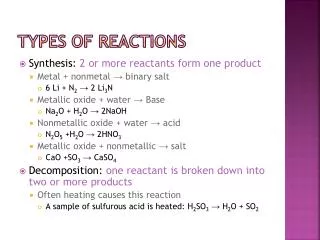
Types of Reactions • Synthesis: 2 or more reactants form one product • Metal + nonmetal → binary salt • 6 Li + N2 → 2 Li3N • Metallic oxide + water → Base • Na2O + H2O → 2NaOH • Nonmetallic oxide + water → acid • N2O5 +H2O → 2HNO3 • Metallic oxide + nonmetallic → salt • CaO +SO3 → CaSO4 • Decomposition: one reactant is broken down into two or more products • Often heating causes this reaction • A sample of sulfurous acid is heated: H2SO3 → H2O + SO2
Types of Reactions: Replacements • Single Replacement • One element replaces one part of a compound • Use activity series • Metal (most common in exercises) : Li>Ca>Na>Al>Zn>Fe>Pb>[H2]>Cu>Ag>Pt • Nonmetal (most common) F2>Cl2>Br2>I2 • The more active replaces the least active • The more active metal replaces • Less active metals in salts 3Mg + 2FeCl3 → 3MgCl + 2Fe • Hydrogen in acids 2Li + 2HCl → H2 + LiCl • Hydrogen in water 2Na + H2O → 2NaOH + H2 • Active nonmetals replace less active nonmetals • Cl2 + 2KI → 2KCl + I2
Types of Reactions: Replacements • Double: the cations and anions switch partners • AX + BY → AY + BX • Driving force: the removal of at least a pair of ions from the solution • Formation of a precipitate • Memorize solubility chart - NO ALTERNATIVE! • Al2(SO4)(aq) + 6NaOH(aq)→ 2Al(OH3)(s) + 3Na2SO4(aq) • Formation of a gas • Common gases: H2S; CO2; SO2; NH3 • these are often a two step reaction with the formation of a substance that breaks down • Na2SO3(aq)+HCl(aq)→ H2O(l) +SO2(g) + 2NaCl (aq) • Really: Na2SO3+HCl → H2SO3 + 2NaCl → H2O +SO2 + 2NaCl • Formation of primarily molecular species • Ca(CH3COO)2(aq) + 2 HCl(l) → CaCl2(aq) + CH3COOH(aq)
Double replacement & acid-base neutralization • Acid + base → salt + water • HA + BOH → AB + HOH • Check solubility rules for the salt! • Polyprotic acids are tricky; if the base is in excess then neutralization occurs • Dilute sulfuric acid is reacted with excess sodium hydroxide: H2SO4(aq)+ 2NaOH(aq) → Na2SO4(aq) + 2H2O(l) • Equal moles of sulfuric acid is reacted with sodium hydroxide: H2SO4(aq)+ NaOH(aq) → NaHSO4(aq) + H2O(l)