Modeling Pb++ Transport in a 1 km Domain with Initial Clean Water and Reaction Intervals
70 likes | 187 Vues
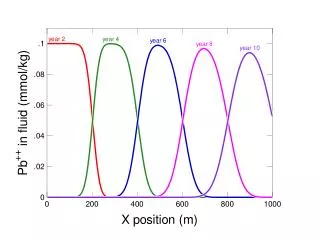
This study explores the transport of Pb++ within a 1 km domain divided into 400 nodal blocks over two distinct reaction intervals. The model initializes with clean water influx (t=0 to 2 years) that carries a Pb++ pulse. From t=2 to 10 years, another inlet introduces negligible Pb++ concentration with clean rinse water. Key parameters include domain size, grid configuration, flow rates, and mass transport properties. Analyzing porosity and its effect on groundwater velocity aids in determining hydrodynamic dispersion coefficients, allowing for trace modeling of Pb++ transport through advection, dispersion, and diffusion.


Modeling Pb++ Transport in a 1 km Domain with Initial Clean Water and Reaction Intervals
E N D
Presentation Transcript
Specify domain’s starting fluid composition on the Initial pane Clean water Start and end times of two reaction intervals
Inlet fluid enters the domain from t = 0 to 2 years Inlet fluid carries Pb++pulse into the domain
Inlet 2 fluid enters the domain from t = 2 to 10 years Clean rinse water: negligible Pb++in the second inlet fluid
Specify domain size, gridding, and flow rate on the Domain pane. Domain is 1 km long, divided into 400 nodal blocks Set flowrate for 1st and 2nd reaction intervals Set specific discharge or head drop
Set various mass transport properties on the Medium pane. Porosity affects groundwater velocity. Used to calculate coefficient of hydrodynamic dispersion. Run → Go traces the model
Pb++pulse transported through the domain by advection, dispersion, and diffusion.