Understanding Cells, DNA, RNA, and Proteins: A Simplified Overview
120 likes | 252 Vues
This resource provides a comprehensive yet simplified explanation of cells, DNA, RNA, and proteins—the fundamental components of life. Cells serve as the basic unit of life, comprising various organelles and complex molecules. DNA, as the primary information carrier, holds the genetic instructions in its nucleotide sequences, while RNA acts as the messenger in protein synthesis. This guide delves into the structures, functions, and mechanisms involve in cellular development and biological processes, making complex concepts more accessible to readers.


Understanding Cells, DNA, RNA, and Proteins: A Simplified Overview
E N D
Presentation Transcript
Cells, DNA, RNA and Proteins Simplified!
Cells • The fundamental unit of life is the cell • A cell consists of a protective membrane surrounding a collection of organelles (subcellular structures) and large and complex molecules that provide cellular structure, energy, and the means for the cell to reproduce • In plants and animals, individual cells cooperate to form multicellular tissues and organ systems that meet the biological needs of the organism • We are interested in biological sequences that regulate all biological processes in cells and organisms • Our primary concern are the instructions for the organization of cells during the development of an organism
DNA • The instruction sequences are stored in very long chemical strings called DNA • DNA is the main information carrier molecule in a cell • DNA may be single or double stranded. • A single stranded DNA molecule, also called a polynucleotide, is a chain of small molecules, called nucleotides. • There are four different nucleotides grouped into two types, • purines: adenineand guanineand • pyrimidines: cytosineand thymine. • They are usually referred to as basesand denoted by their initial letters, A, C, Gand T
DNA • Different nucleotides can be linked together in any order to form a polynucleotide, for instance, like this A-G-T-C-C-A-A-G-C-T-T • Polynucleotides can be of any length and can have any sequence • The two ends of this molecule are chemically different, i.e., the sequence has a directionality, like this A->G->T->C->C->A->A->G->C->T->T-> • The end of the polynucleotides are marked either 5' and 3' . • By convention DNA is usually written with 5' left and 3' right, with the coding strand at top.
DNA • Two strands are said to be complementaryif one can be obtained from the other by • mutually exchanging A with T and C with G, and • changing the direction of the molecule to the opposite. A->G->T->C->C->A->A->G->C->T->T-> <-T<-C<-A<-G<-G<-T<-T<-C<-G<-A<-A
DNA • Specific pairs of nucleotides can form weak bonds between them • A binds to T, C binds to G. • Although such interactions are individually weak, when two longer complementary polynucleotide chains meet, they tend to stick together 5' C-G-A-T-T-G-C-A-A-C-G-A-T-G-C 3' | | | | | | | | | | | | | | | 3' G-C-T-A-A-C-G-T-T-G-C-T-A-C-G 5' • Vertical lines between two strands represent the forces between them as shown above. • The A-T and G-C pairs are called base-pairs (bp). • The length of a DNA molecule is usually measured in base-pairs or nucleotides (nt), which in this context is the same thing.
DNA Double Helix Two complementary polynucleotide chains form a stable structure, which resembles a helix known as a the DNA double helix. About 10 bp in this structure takes a full turn, which is about 3.4 nm long.
DNA • It is remarkable that two complementary DNA polypeptides form a stable double helix almost regardless of the sequence of the nucleotides • This makes the DNA molecule a perfect medium for information storage • Note that as the strands are complementary, either one of the strands of the genome molecule contains all the informatiion • Thus, for many information related purposes, the molecule used on the example above can be represented as CGATTCAACGATGC • The maximal amount of information that can be encoded in such a molecule is therefore 2 bits times the length of the sequence • Noting that the distance between nucleotide pairs in a DNA is about 0.34 nm, we can calculate that the linear information storage density in DNA is about 6x10 8 bits/cm • Which is approximately 75 GB
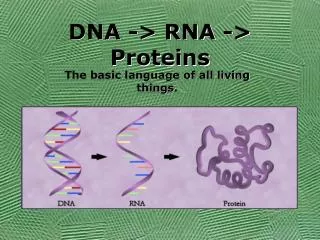
DNA • Regions in the DNA sequence encode instructions for the manufacture of proteins in the cell • Proteins are linear chains whose elements come from a set of 20 chemically active building blocks known as amino acids. • Each protein has a unique sequence of amino acids that is determined by a DNA sequence on the chromosomes. • The proteins enable an organism to build needed structures and to carry out its biological functions. • Using a specific biological mechanism – transcription– the DNA is “read” and searched for specific patterns that mark the beginning and end of hereditary information • That information is the gene
RNA • Transcription produces another long string called messenger RNA (mRNA) • The mRNA is what actually specifies the amino acid sequence. • mRNA molecules are very similar structurally and chemically to DNA • Exceptions: they are single-stranded and have a new base – uracil (M) – instead of thymine (T). It also has a different backbone sugar. Translation • mRNA also has specific regions indicating the start of the code for a protein • Large organelles in the cytoplasm (ribosomes) bind to the start sites • Then move in a defined chemical direction , reading length-three base sequences (codons) at a time • Each codon specifies an amino acid • The corresponding amino acid is then added to a growing chain that comprise the protein • This continues until one of several stop codons is reached
Genetic Code • Dictionaries are the natural Python representation of tabular data. • Next time, we will illustrate this with a representation of the codon table for protein synthesis
Transcription and Translation • Once formed, proteins rapidly fold from a linear string into simple helical and stranded elements • These new components are then organized into a complex three-dimensional structure • The resulting protein molecule may serve as a tissue building block or have a very specific chemical activity • The collection of proteins produced by an organism, the proteome, is responsible for the organism’s structure and biological behavior.