Download
1 / 11
110 likes | 220 Vues
This guide explains the core processes of molecular biology, detailing how genes encoded in DNA are transcribed into messenger RNA (mRNA) and ultimately translated into proteins. A gene represents a small segment of DNA that specifies a particular protein, while RNA serves as the intermediary that conveys this information. It outlines the roles of RNA polymerase in transcription, the function of ribosomes in translation, and the significance of transfer RNA (tRNA) in assembling amino acids into polypeptide chains. Understanding these processes is fundamental to comprehending life at a molecular level.

E N D
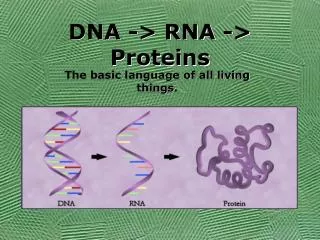
DNA -> RNA -> Proteins The basic language of all living things.
A Gene • A gene is a section of DNA that codes for a specific protein • Only a very small percentage of our DNA (perhaps 1%) actually does this
RNA - ribonucleic acid • RNA is short compared to DNA • RNA has one strand instead of two • C, G, A, and U (uracil) instead of C,G,A, and T • (U takes the place of T)
Messenger RNA • DNA is a large and bulky molecules, it does not travel well, so when it wants to make a protein it makes and mRNA copy of the instructions
Transcription • This process is called transcription, because the DNA transcribes “copies” itself • It takes advantage of base pairing
RNA Polymerase • An enzyme called RNA Polymerase makes all of this happen • The enzyme puts the new nucleotides in place
mRNA finds a ribosome • mRNA moves out of the nucleus into the cytoplasm of the cell where it finds a ribosome • The ribosome is made of RNA and it will serve as a work bench for making proteins
Translation • Once attached to the ribosome, the mRNA is translated from the language of nucleic acids to the language of amino acids • Each three letter word or “codon” calls for one amino acids
tRNA • It is the job of the transfer RNA is to transfer the correct amino acid to the correct mRNA codon
Polypeptide chain • In this way a polypeptide is made • Each time a a tRNA connects to a mRNA one amino acid is added to the growing chain
Summary • Can you label all of the parts in this diagram? • A_________ • B_________ • C_________ • D_________ • E_________ DNA mRNA Amino Acid tRNA Ribosome