Robust Global Registration
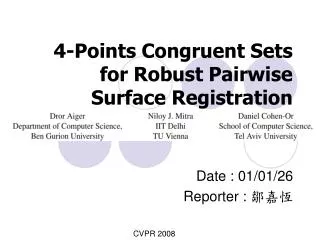
This paper addresses the shape registration problem, focusing on the alignment of partially overlapping shapes P and Q using rigid transforms to minimize squared distance. We explore various approaches, including iterative minimization (ICP), voting methods, and geometric hashing. Our methods utilize local features, integral volume descriptors, and efficient search algorithms to improve correspondence identification. We highlight challenges like unknown overlaps and the correspondence problem while ensuring robustness with sparse features and effective pruning strategies. Future work aims to refine these techniques further.


Robust Global Registration
E N D
Presentation Transcript
Robust Global Registration Natasha Gelfand Niloy Mitra Leonidas Guibas Helmut Pottmann
Registration Problem Given: Two shapes P and Q which partially overlap. Goal: Using only rigid transforms, register Q against P by minimizing the squared distance between them.
Applications • Shape analysis • similarity, symmetry detection, rigid decomposition • Shape acquisition [Anguelov 04] [Koller 05] [Pauly 05]
Approaches I [Besl 92, Chen 92] • Iterative minimization algorithms (ICP) • Properties • Dense correspondence sets • Converges if starting positions are “close” 3. Iterate 2. Align corresponding points 1. Build a set of corresponding points
Approaches II [Stockman 87, Hecker 94, Barequet 97] • Voting methods • Geometric hashing, Hough transform, alignment method • Rigid transform can be specified with small number of points • Try all possible transform bases • Find the one that aligns the most points • Guaranteed to find the correct transform • But can be costly
Approaches III [Mokh 01, Huber 03, Li 05] • Use neighborhood geometric information • Descriptors should be • Invariant under transform • Local • Cheap • Improves correspondence search or used for feature extraction
Registration Problem • Why it’s hard • Unknown areas of overlap • Have to solve the correspondence problem • Why it’s easy • Rigid transform is specified by small number of points • Prominent features are easy to identify We only need to align a few points correctly.
Method Overview • Use descriptors to identify features • Integral volume descriptor • Build correspondence search space • Few correspondences for each feature • Efficiently explore search space • Distance error metric • Pruning algorithms
Integral Descriptors [Manay 04] • Multiscale • Inherent smoothing f(x) Br(p) p
0.20 Integral Volume Descriptor • Relation to mean curvature
Descriptor Computation • Approximate using a voxel grid • Convolution of occupancy grid with ball
Feature Identification • Pick as features points with rare descriptor values • Rare in the data [ rare in the model [ few correspondences • Works for any descriptor Features
Multiscale Algorithm • Features should be persistent over scale change
Feature Properties • Sparse • Robust to noise • Non-canonical
Correspondence Space • Search the whole model for correspondences • Range query for descriptor values • Cluster and pick representatives Q P
Evaluating Correspondences • Coordinate root mean squared distance • Requires best aligning transform • Looks at correspondences individually
Rigidity Constraint • Pair-wise distances between features and correspondences should be the same Q P
Rigidity Constraint • Pair-wise distances between features and correspondences should be the same Q P
Rigidity Constraint • Pair-wise distances between features and correspondences should be the same Q P
Evaluating Correspondences • Distance root mean squared distance • Depends only on internal distance matrix
Q P Search Algorithm • Few features, each with few potential correspondences • Minimize dRMS • Exhaustive search still too expensive
Search Algorithm • Branch and bound • Initial bound using greedy assignment • Discard partial correspondences that fail thresholding test • Prune if partial correspondence exceeds bound • Spaced out features make incorrect correspondences fail quickly • Since we explore the entire search space, we are guaranteed to find optimal alignment • Up to cluster size Rc qi pi pj qj
Search Algorithm • Branch and bound • Initial bound using greedy assignment • Discard partial correspondences that fail thresholding test • Prune if partial correspondence exceeds bound • Spaced out features make incorrect correspondences fail quickly • Since we explore the entire search space, we are guaranteed to find optimal alignment • Up to cluster size
Greedy Initialization • Good initial bound is essential • Build up correspondence set hierarchically …
Greedy Initialization • Good initial bound is essential • Build up correspondence set hierarchically … …
Greedy Initialization • Good initial bound is essential • Build up correspondence set hierarchically …
Partial Alignment • Allow null correspondences, while maximizing the number of matches points
Alignment Results Input: 2 scans Our alignment Refined by ICP
Alignment Results Our alignment Refined by ICP Input: 10 scans
Symmetry detection Match a shape to itself Symmetry Detection
Rigid Decomposition • Repeated application of partial matching
Conclusions • Simple feature identification algorithm • Used integral volume descriptor • Applicable for any low-dimensional descriptor • Correspondence evaluation using dRMS error • Look at pairs of correspondences, instead of individually • Efficient branch and bound correspondence search • Finds globally best alignment
Future Work • Linear features
Future Work • Linear features • Fast rejection tests • More descriptors
Acknowledgements • Daniel Russel • An Nguyen • Doo Young Kwon • Digital Michelangelo Project • NSF CARGO-0138456, FRG-0454543, ARO DAAD 19-03-1-033, Max Plank Fellowship, Stanford Graduate Fellowship, Austrian Science Fund P16002-N05