Understanding Biological Communities and Ecological Niches
This chapter explores the dynamics of biological communities, emphasizing the interactions among organisms that coexist in specific environments. It discusses the individualistic concept of communities and how species evolve, forage, compete, and cooperate together. The ecological niche is introduced, detailing the differences between fundamental and realized niches. The text also examines species interactions, including predation, symbiosis, and the impact of keystone species. Key concepts such as resource partitioning, coevolution, and community structure are highlighted to illustrate the complexity of ecological relationships.

Understanding Biological Communities and Ecological Niches
E N D
Presentation Transcript
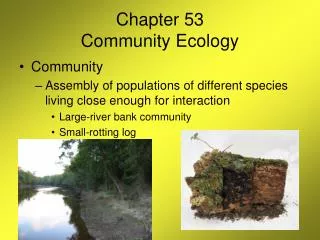
Biological Communities • Community: all the organisms that live together in a specific place • Evolve together • Forage together • Compete • Cooperate
Biological Communities • Individualistic concept: a community is a group of species that happen to occur together at one place • species respond independently to changing environmental conditions • The composition of a Community can change
Ecological Niche • Niche: An Organism’s way of life • Habitat • Food • Temp. range • Reproduction
Ecological Niche • Fundamental niche: the entire niche that a species is capable of using. • Realized niche: actual niche in which the species can establish a stable population
Ecological Niche study of barnacles
Billock Billock Ecological Niche • causes of niche restriction • Competition • Predators • Absence of pollinators • Presence of herbivores
Ecological Niche • Principle of competitive exclusion: no two species can occupy the same niche when resources are limited • Species may divide up the resources, (resource partitioning) • natural selection can then lead to adaptive radiation
Ecological Niche Character displacement in Darwin’s finches
Predator-Prey • Predation and coevolution • Predation provides strong selective pressure on the prey population • Features that decrease the probability of capture are strongly favored • Predator populations counteradapt to continue eating the prey Coevolution race
Examples of prey adaptations: • Chemical defenses • Camouflage • Warning coloration • mimicry
Species Interactions • Symbiosis: two or more kinds of organisms interact in more-or-less permanent relationships • All symbiotic relationships carry the potential for coevolution • Three major types of symbiosis • Commensalism • Mutualism • Parasitism
Species Interactions • Commensalism benefits one species and is neutral to the other • Spanish moss: an epiphyte hangs from trees
Species Interactions • Mutualism benefits both species • Coevolution: flowering plants and insects Ants and acacias • Acacias provide hollow thorns and food • Ants provide protection from herbivores
Species Interactions • Parasitism benefits one species at the expense of another • Can be external or internal parasites
Species Interactions External parasite: the yellow vines are the flowering plant dodder, it is a parasite that obtains its food from the host plant it grows on
Species Interactions • Ecological processes can interact • Predation reduces competition • Superior competitors become more numerous and attract predators • This allows other species to survive when they could have been out competed
Species Interactions Starfish eat barnacles, allowing other species to thrive instead of being crowded out by the explosive population of barnacles
Species Interactions • Keystone species: species whose effects are greater than expected • Examples: • Sea star predation on barnacles • Beaver ponds • Top predators
Species Interactions Beavers construct dams and transform flowing streams into ponds, creating new habitats for many plants and animals