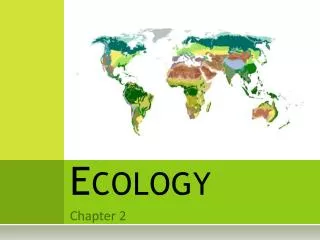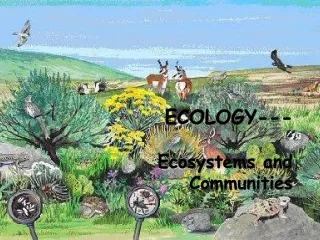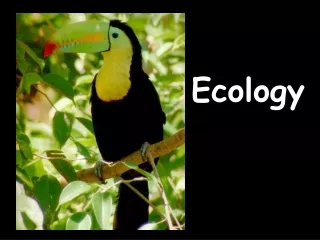
Ecology
Ecology. To Those Who Shall Inherit the Earth…. Flow of Energy. Love is energy and energy is everything. What is an Ecosystem?. Interactions among biotic (living) and abiotic (nonliving) factors Let’s try to draw one. How does energy move?. Essentially all energy comes from the sun

Ecology
E N D
Presentation Transcript
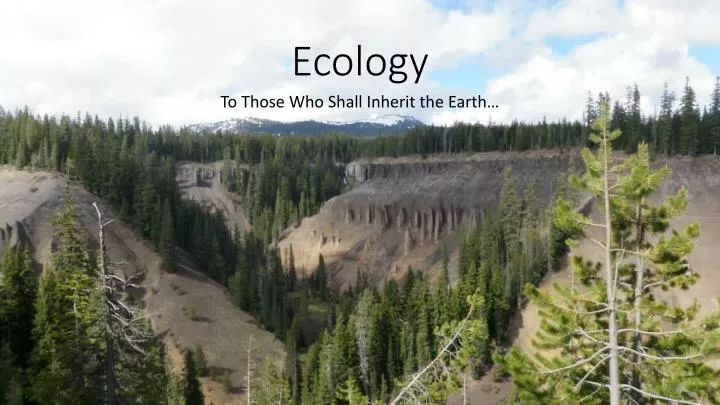
Ecology To Those Who Shall Inherit the Earth…
Flow of Energy Love is energy and energy is everything
What is an Ecosystem? • Interactions among biotic (living) and abiotic (nonliving) factors • Let’s try to draw one
How does energy move? • Essentially all energy comes from the sun • Moves from autotrophs (plants) to heterotrophs (not plants) • Heterotrophs (aka. Consumers) – must consume energy; cannot make their own • Autotrophs (aka. Producers) – Produce their own energy • Most use radiant energy from the sun to produce chemical energy in the form of glucose sugar • What is this process called? Photosynthesis!
What about the other producers? • MOST use photosynthesis to produce energy • Others use energy from chemical reactions to produce organic molecules • Called Chemosynthesis • Bacteria and archaea
How do other organisms obtain energy? • Heterotrophs or consumers – take in energy by breaking down compounds in organisms they eat • Trophic levels: • Producers • Primary consumers – eat producers • Secondary consumers – eat primary consumers • Tertiary consumers – eat secondary consumers • Quaternary consumers – eat… guess what they eat? • Organisms participate in different levels
What are decomposers? • Usually fungi or bacteria • Decomposers obtain energy from organic wastes • fallen leaves or dead organisms • Fungi usually break down plant matter • Bacteria usually break down animal matter • Break down complex molecules into simpler ones • Helps cycle carbon and nitrogen elements • Use secreted enzymes to break down food • Enzymes – special proteins that speed up reactions
Are there ways to show energy flow? • There are 2! • Food chains – path of energy from producer to decomposer • Food web – chains that interconnect through multiple feeding relationships • Arrows point the direction of energy flow from one organism to the next (What’s doing the eating) • Energy travels in 1 direction • Energy does NOT cycle through the ecosystem, unlike matter • What would be the simplest food chain? Producer consumer Chain Web
What types of eating habits are there? • Herbivore – eats only producers (eats plants) • Omnivore – eats both producers and consumers (eats plants and animals) • Carnivore – eats consumers (eats meat only)
Is there a model for energy flow? • Lets go back to the ecosystem drawing • Models are visual depictions that make a feature of the world easier to understand and are used to make predictions and test hypotheses etc… • Food pyramids are models for energy flow • Must show feeding relationships in food chains as well as amount of energy passed up trophic levels • 10% of energy is ALL that passes to the next trophic level
Checkpoint • Use the following food chain to create an energy pyramid: Grass mouse snake hawk • If the amount of energy present in the producers of this pyramid is 1.35 x 10⁵ kilocalories, identify how much energy is present in each trophic level • What if we add decomposers to consume the hawk after it dies?
Assignment! • Paper – pencil food chain lab • Complete the packet – due tomorrow • Materials • Packet • Writing utensil (no red, pink, or green) • Scissors • Glue
Biogeochemical cycles What goes around comes around
What are biogeochemical cycles? • Bio = life • Geo = earth • Chemical = chemical • So, biogeochemical cycles are the patterns that elements and chemicals move through and between biotic organisms and their abiotic environment • 3 major cycles include: • Carbon – oxygen cycle • Nitrogen cycle • Water
How does the carbon-oxygen cycle work? • C and O exist in all organisms • Both exist in the atmosphere as CO2 and O2 • Steps • Plants take in CO2 using _____________ and convert it into carbohydrates • Plants release O2 • Animals take in O2 and release through CO2 respiration • Decomposers break down C stored in dead organisms and return it to the atmosphere photosynthesis
What is the “geo” part of the carbon-oxygen cycle? • Carbon is also released into the atmosphere by: • burning fossil fuels • Volcanic eruptions • Human or naturally caused forest fires
Where do fossil fuels come from? • Carbon in the bodies of deceased organisms that lived millions of years ago were subjected to heat and pressure deep within Earth turning them into fossil fuels • Any combustion reaction (anytime you burn organic things), CO2 and water vapor are produced AND oxygen is consumed • Burning fossil fuels • Burning wood for fuel/forest fires • Forest fires
What is the nitrogen cycle and why is it important?? • Movement of nitrogen through the organisms, water, rocks, minerals, and atmosphere • Nitrogen is ESSENTIAL to living things as it makes up: • Nucleic acids and DNA • Amino acids and proteins • ATP (high energy molecule used for cellular energy)
How does nitrogen move through the cycle? • Atmosphere contains approximately 78% nitrogen… that most organisms cant use • Nitrogen fixation into ammonia (ammonification)changes nitrogen into a usable form for organisms done by: • Soil bacteria • Certain plants, called legumes, have a mutualistic relationship with certain bacteria that allow nitrogen fixation • Ex. Peanuts, most beans, and peas
What happens after the nitrogen is fixed? • Assimilation - Plants absorb nitrogen once it is in the form of usable nitrates • Animals obtain nitrogen by eating plants • Nitrogen in animals is passed through the food chain and returned to decomposers • In low oxygen environments bacteria convert nitrogen to gas which returns to the atmosphere = denitrification • Marine environments • Soil
What is the hydrologic cycle? • Water cycle • Driven by energy from the sun • Important steps: • Evaporation – liquid to gas by energy from sun or heat • Condensation – gas to liquid • Precipitation – falls • Respiration – water vapor produced by cells when breaking down glucose • Transpiration – liquid to gas through plants • Vascular plants (large plants) use a tissue called xylem to move water up the plant • Water leaves through holes in leaves called stomata
Assignment! • Complete the worksheet for biogeochemical cycles • Color AND answer questions • Use the document to help you answer questions • Materials • Colored pencils or crayons • Pencil • Due tomorrow
Symbiotic Relationships Living together isn’t always easy
What is the hierarchy of biological systems? • Atoms – come together to make: • Molecules – come together to make: • Organelles – come together to make: • Cells - come together to make: • Tissues - come together to make: • Organs - come together to make: • Organ systems – come together to make: • Organism - come together to make: • Populations - come together to make: • Communities - come together to make: • Ecosystems - come together to make: • Biosphere We’ll focus on these for now
What are the parts of ecology hierarchy?? • Population - A group of organisms of the SAME species living together • Community – A group of organisms of DIFFERENT species living together • Ecosystem – A group of living and non-living things in an environment • Biosphere– all living things on Earth
How do ecosystems remain stable? • Population of individual species will cycle regularly and predictably as energy flow remains fairly constant • Organisms live in habitats • Depends on availability of water, shelter, and food • The role and organism plays in its environment is its niche • What it eats, where it eats, and its effect on the environment
Can organisms occupy the same habitat and niche? • Organisms may have the same habitat • Organisms may NOT have exactly the same niche within the habitat • 2 plants may both live in the same habitat – occupy the same niche – but they may require different amounts of light
Can organisms live together? • Yes these types of relationships are called symbiotic/symbiosis • Symbiosis is an interdependent relationship between two different organisms or a different species – at least 1 of them ALWAYS benefits • Mutualism – both species benefit • Commensalism – one organism benefits and the other is unaffected • Parasitism – one organism benefits and one is harmed Each X represents a different organism
Assignment! • Symbiotic relationships cut and paste • Due tomorrow • Materials: • Scissors • Glue or tape • Worksheet
What about other relationships? • Predator – prey: one organism kills and eats another • Key role in the ecosystem keeping population sizes balanced • Populations that are too high are prone to: • Starvation • disease
What about organisms that require the same things? • They compete: interact where they try to use the same resources at the same time • Intraspecific competition – organisms of the same species compete for food, water, shelter, mates • Interspecific competition – organisms of different species compete for food, water, shelter • Most successful competitors are best adapted to their ecosystem
Assignment • Online virtual lab examining competition • Found here: http://glencoe.mheducation.com/sites/dl/free/0078757134/383928/BL_04.html • Materials: • Computer • Internet • Handout • Pen/pencil
Why do organisms communicate? • They communicate to their own and to other species • Helps organisms survive by allowing them to: • ID themselves • Attract mates • Warn of predators • Protect living space – territory (can be small or large) • Many animals use chemical markers to identify their territory • Many animals use sound to warn another animal they are encroaching • Many animals will fight to defend their territory
How do organisms communicate? • Sound • Ex: Whale songs, wolf howls, your nonstop chatter • Visual • Ex. Waggle dance in bees, courtship dances • Chemical • Ex. Pheromones – chemicals used by one organism to elicit a response from another (used by bees, ants, etc…)
Assignment! • Population dynamics worksheet • Due tomorrow • Materials: • Two colored pencils or pens (you may use patterns on your graph to distinguish between species if you wish to use 1 pencil or pen) • Graphing worksheet
Population dynamics What goes up must come down
Brief Review: • What is a population? • All the organisms of the same species living in an area • What is the hierarchy of ecology? • Organisms population community ecosystems biosphere • Tell me the factors discussed so far that determine population change? • Number of predators • Amount of resources (food, water, shelter) • Number of mates • Disease
What makes up an ecosystem? • Biotic factors – living things • Other organisms: bacteria, plants, animals, fungi, protists (5 kingdoms) • Abiotic factors - non living things • Rocks, sunlight, temperature, precipitation, inorganic chemicals (sodium, nitrogen, potassium, etc…)
How do populations grow and decline? • Affected by 4 factors: • Births • Deaths • Immigration – movement of organisms INTO an area • Emigration – movement of organisms OUT OF an area • Population equation: • Pop. = (births + immigration) – (deaths + emigration) • When (deaths + emigration outnumber (births + immigration), what happens to the population?
What makes birth and death rates rise? • Birth rates: • Usually higher in developing countries • Tend to rise when there is a need for more people to work • Death rates: • Usually higher in developing countries • Result from lack of food and water • Also result from lack of medical care and sanitation (enable rapid spread of disease)
What makes birth and death rates fall? • Birth: • Usually lower in developed countries • Increase cost in having children • Death: • Usually also lower in developed countries • Better medical care • Better sanitation and personal hygiene • Better access to food and water • Changes in population • If population cannot adapt to changing environments they decline • If populations do adapt to changing environments they increase
Is there selection for survival? K selection (think kanagaroo) R selection (think roaches) Many babies born to an individual organism Little to no parental care Quick maturation Short gestation Short life span • Few babies born to an individual organism • High amount of parental care • Slow maturation • Long gestation • Long life span
Assignment! Estimating population lab part 1 Estimating population lab part 2 Random sampling Materials: Paper for cutting 2 baggies Scissors (optional) Handout Pencil/pen • Mark and recapture method • Materials: • plastic baggie • A lot of white beans • 10 black beans • Handout • Pencil/pen
What limits population size? • Most population stabilize over time or reach carrying capacity • Carrying capacity – number of organisms an environment can support • Limiting factors – are biotic or abiotic things in the environment that control population • Number of predators – biotic • Disease – biotic • Amount of food – biotic (food is organic) • Precipitation – abiotic • Sunlight – abiotic • Amount of water – abiotic
What kind of limiting factors depend on population density? • Density – dependent limiting factor – limits the population based on the size of the population • Biotic factors • Have more affect on the population when numbers are high • Include: • Competition • What do organisms compete for? • Predation • Parasitism • Disease • Tuberculosis
What kind of limiting factors don’t depend on population density? • Density-independent limiting factors – control growth of population regardless of density • Abiotic factors • Do not depend on the size of the population to control population • Include: • Forest fires • Droughts • Tsunamis • Other natural disasters • Pollution caused by humans
When does a population stabilize? • Populations are stable when they reach their carrying capacity • Carrying capacity – the number of organisms an ecosystem can supportdue to limited resources • Can change as amount of resources change • Creates an S shaped curve on a population graph • What’s happening to the factors in the population equation?
How is carrying capacity affected by ecosystems? • Depends on: • number of organisms living there • Size of the ecosystem • Available resources • Rainforests have higher carrying capacity than a desert • Large areas of land have higher carrying capacities than small areas of land
What happens when a population does not stabilize? • Exponential growth – population continues to grow and does not show presence of limiting factors • J shaped curve • Only population known to currently do this is humans