Coccidia
Coccidia. characterized by thick-walled oocysts excreted in feces. In Humans Cryptosporidium Isospora Cyclospora Sarcocystis Toxoplasma. GENERAL APICOMPLEXAN LIFE CYCLE. Cryptosporidium parvum. first human case reported in 1976 monoxenous, wide range of animal hosts

Coccidia
E N D
Presentation Transcript
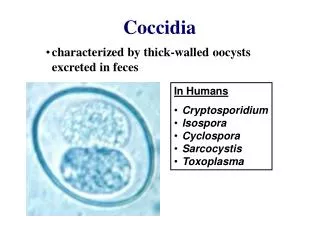
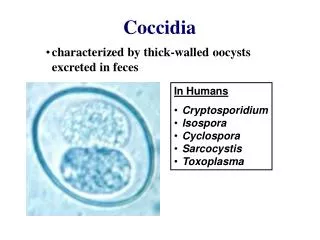
Coccidia • characterized by thick-walled oocysts excreted in feces • In Humans • Cryptosporidium • Isospora • Cyclospora • Sarcocystis • Toxoplasma
Cryptosporidium parvum • first human case reported in 1976 • monoxenous, wide range of animal hosts • several host-adapted species? • self-limiting diarrhea in immunocompetent • profuse, watery diarrhea associated with AIDS • life threatening
Extracytoplasmic Location • microvilli extend and fuse to enclose zoite • close association between parasite and host intestinal epithelial cell • called adhesive zone, feeder organelle, etc
Cryptosporidium Life Cycle • Merogony • = schizogony • Gametogony • = gamogony or • = gametocytogenesis • Sporogony • completed in host cell • thin (autoinfection) or thick walled oocysts
Water Borne Outbreaks of Cryptosporidiosis in the USA Modified from Graczyk et al, Parasitol. Today 13:348 (1997)
The Milwaukee Outbreak NEJM 331:161 (1994) • massive cryptosporidiosis outbreak following spring thaw • >400,000 people may have been affected • based on clinical symptoms (acute watery diarrhea) • treated water had high levels of turbidity 3/23-4/5/1993 • oocysts identified in ice made during this period • 100-fold higher prevalence of Cryptosporidium oocysts in stools • other enterics (including Giardia, bacteria, viruses) were at ~normal levels
Factors Favoring Waterborne Cryptosporidiosis • small size of oocysts (4-5 mm) • reduced host specificity and monoxenous development • close associations between human and animal hosts • large number of oocysts excreted (up to 100 billion per calf per day) • low infective dose (<30) • robust oocysts; resistant to chlorine • infectious sporulated oocysts excreted in feces
Human Cryptosporidiosis • associated with epidemic diarrhea in institutions and hospitals • highly transmissible (19% household members)
Molecular Epidemiology Peng et al (1997), Emerg. Inf. Dis. 3:567 • 2 genotypes identified from 39 isolates: • Genotype 1 • only human sources • non-infective for mice or calves • Genotype 2 • human and bovine sources • infective for mice and calves
Two distinct transmission cycles: • anthroponotic (genotype 1) • zoonotic (genotype 2)
Symptoms of 205 patients with Confirmed Cases of Cryptosporidiosis During the Milwaukee Outbreak
Pathogenesis • enterocytes damaged or killed • villus atrophy (blunting) • Na+ absorption • permeability • crypt cell hyperplasia • Cl- secretion • inflammation in lamina propria • cytokines and neurohormones? • enhanced secretion of antibodies (IgA)? • DIARRHEA • enterocyte malfunction (osmotic) • impaired absorption • enhanced secretion • inflammatory diarrhea • mucosal invasion • leukocytes in stools • secretory diarrhea • toxin • watery
Isospora belli • wide geographical distribution (higher prevalence in warmer climates) • monoxenous, probably not zoonosis • invades intestinal epithelial cells • often asymptomatic (seldom reported) • symptoms range from mild gastro-intestinal distress to severe dysentery • often self-limiting, but can become chronic (wasting, anorexia) • symptoms more severe in AIDS patients
Cyclospora cayetanensis • first human case in 1979 • named in 1993 • initially called ‘cyano-bacteria like body’ (CLB) or large Cryptosporidium • related to Eimeria • life cycle unknown • oocysts mature in environment • similar to Isospora? • zoonosis?
Clinical Features • symptoms similar to Cryptosporidium and Isospora • watery diarrhea/frequent stools • 1-2 week duration typical • relapses over 1-2 months • associated with food-borne outbreaks • 37/64 attendees at luncheon near Charleston SC were positive for Cyclospora • raspberries from C. America was source? • oocysts detected on market vegetables in Peru • presumed source: contaminated water or human waste as fertilizer
Intestinal Coccidia • Diagnosis • demonstration of oocysts in feces • acid-fast stain (all three) • autofluorescence (Isospora and Cyclospora) • direct observation (Isospora) • Treatment • paromomycin for Cryptosporidium • modest benefit • lowers parasitemia in AIDS • trimethoprim-sulfamethoxazole for Cyclospora and Isospora
Cryptosporidium • 4-5 mm oocysts • 4 sporozoites • no sporocysts • Cyclospora • 8-10 mm oocyts • 2 sporocysts • 2 sporozoites each • Isospora belli • 30 x 12 mm oocyts • 2 sporocysts • 4 sporozoites each
Cryptosporidium • 4-5 mm oocysts • 4 sporozoites • no sporocysts • Cyclospora • 8-10 mm oocyts • 2 sporocysts • 2 sporozoites each • Isospora belli • 30 x 12 mm oocyts • 2 sporocysts • 4 sporozoites each
Cryptosporidium • 4-5 mm oocysts • 4 sporozoites • no sporocysts • Cyclospora • 8-10 mm oocyts • 2 sporocysts • 2 sporozoites each • Isospora belli • 30 x 12 mm oocyts • 2 sporocysts • 4 sporozoites each