
Galaxies
E N D
Presentation Transcript
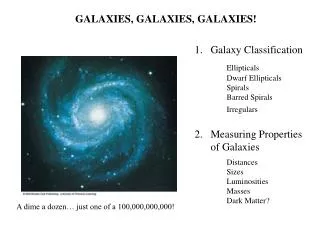
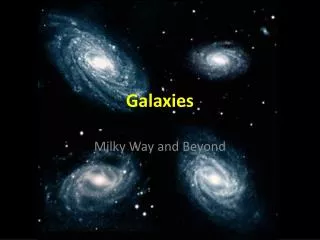
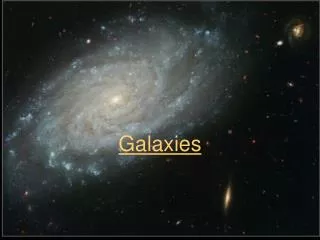
Galaxies • A galaxy is a huge region of space that contains hundreds of billions of stars, planets, glowing nebulae, dust, empty space, and possibly black holes. • Galaxies began when large clouds of gas and dust started to shrink as a result of their gravity.
Galaxies • Galaxies are held together by gravity. • According to Hubble’s Law, galaxies are moving away from one another. • 100 billion or so exist in the universe.
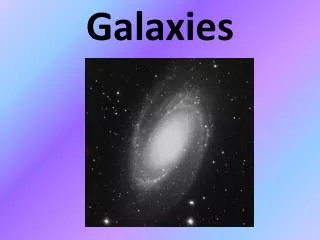
Shapes of Galaxies • Hubble categorized these shapes or basic schemes of galaxies: 1. Spiral 2. Elliptical (nearly circular) 3. Irregular
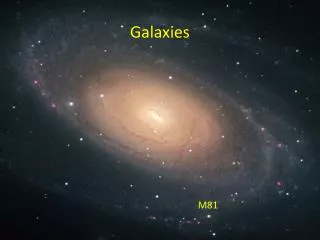
Spiral Galaxies • Arms tightly wound around galaxy, like a pinwheel • A group of objects in center (stars and possibly a black hole) • Surrounded by a halo and an invisible cloud of matter.
Spiral Galaxies • Rotating – which forms arms • May lose arms and become elliptical • Examples: Milky Way and Andromeda Galaxies
Elliptical Galaxies • Can be round, oval, flattened or spherical • Resembles the nucleus of a spiral galaxy without the arms • Very little gas or dust
Elliptical Galaxies • Mostly older stars • Collect into globular clusters • Examples: Maffei 1, M32
Irregular Galaxies • Neither spiral or elliptical • Disk, but no spiral arms • Caused by the formation of new stars in the galaxy or by the pull of neighboring gravitational fields
Irregular Galaxies • In some irregular galaxies one can see individual stars, nebulae, and clusters • Mixture of old and new stars • Large amounts of gas and dust • Examples: Large and Small Magellanic Clouds
Barred Spiral Galaxies • Spirals with bright bar of gas down center.
Lenticular Galaxies • Consists of bulge and disk with little or no new star formation. • Example: Spindle Galaxy
Parts of a Galaxy • The galaxy is made up of two visible components: 1. Disk 2. Bulge
Parts of a Galaxy – The Disk • Contains clouds of gas and dust called nebulae • In a spiral galaxy, most stars are in the disk • Open Cluster (Galactic Clusters) are younger, asymmetric groups of stars.
Parts of a Galaxy – The Disk • An example of a galactic cluster is Pleiades (M45)
Parts of a Galaxy - Bulge • A large squashed sphere surrounding the galaxy’s center • Contains older stars • Not very much gas or dust • One fifth of the total light comes from the bulge
Parts of a Galaxy - Bulge • The bulge can be used to determine the age of the galaxy • Above and around the bulge are globular clusters – hundreds of thousands of stars bound in a tight spherical swarm
Parts of a Galaxy - Bulge • An example of a globular cluster is M13 (Hercules Globular Cluster)
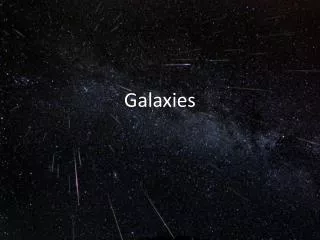
The Milky Way Galaxy • Over 100 billion stars and possibly a black hole in the center. • Has star clusters, planets, glowing nebulae, dust and empty space. • Older stars and globular cluster near the center
The Milky Way Galaxy • Younger stars and galactic clusters in disk • One hundred thousand (100,000) light years in diameter. Ten thousand (10,000) light years thick • Our solar system is located on the Orion Arm – 30,000 light years from the center.
The Milky Way Galaxy • Part of the Local Group of galaxies with 30 others. (Andromeda is also part of this group) • Astronomers use radio and infrared telescopes to “see” the center of the galaxy • We can’t actually “see” the center of the galaxy because of dust and gas!
The Milky Way Galaxy • The Milky Way is getting larger because it is “eating” the Large Magellanic Cloud. Its stars are being added to the Milky Way. • The Milky Way is falling toward the Andromeda Galaxy and both are feeling the tug of the great Virgo Cluster, which is 50 million light years away.
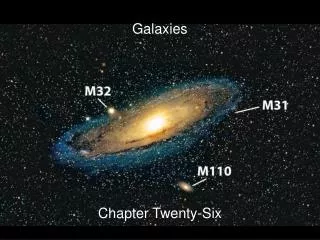
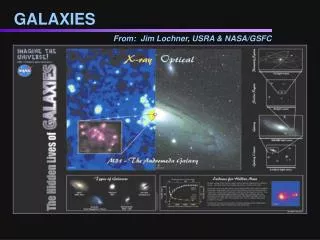
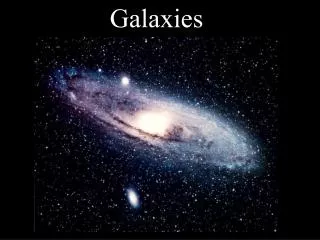
Andromeda Galaxy (M31) • Can only be seen by astronomers in the Northern hemisphere • 2.2 million light years away • Can see without a telescope, appears as a faint fuzzy patch • About the same size as the Milky Way • Two times more massive than the Milky Way
Large and Small Magellanic Clouds • Can only be seen by astronomers in the Southern Hemisphere • The two closest galaxies to the Milky Way (Less than 200,000 light years away) • Visible to the naked eye
Large and Small Magellanic Clouds • Relatively small and irregular in shape • Only five percent of the mass of the Milky Way • Large Magellanic is being “eaten” by the Milky Way
Messier Catalog System • Charles Messier was looking for comets. • Made a list of star clusters, galaxies and nebula so that he would not mistake them for comets. • Listed 110 objects, including 32 galaxies by 1780. • Andromeda – M31