Download
1 / 6
60 likes | 183 Vues
This overview delves into the significance of Martin Luther's early life, highlighting his upwardly mobile background, education in law, and the trauma that led to his monastic vocation. It examines the intersections between humanism and the Reformation, revealing Luther's concept of faith and sin, and his groundbreaking theological insights. Key discussions include his understanding of the distinction between law and gospel, the implications of indulgences, and the role of suffering in faith. This study provides a comprehensive look at Luther's transformation and foundational teachings.

E N D
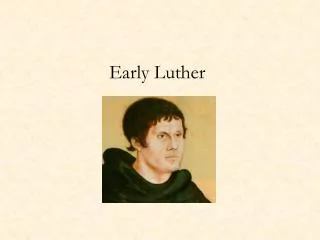
Early Life • Background: upwardly mobile • Education: law • Conversion: trauma leads to monastic vocation • Questions: • What is the relationship between humanism and the Reformation? • Biblical scholarship • Church reform, ethical renewal • What is the meaning of the phrase facere quod in se est?
From monastic to academic life • Monastic life: Augustinian order of canons (Source 2.1) • Life according to a rule • Monks as priests • Questions: • What was Frederick the Wise's relationship to the University of Wittenberg? Why was it important to him? • What is the meaning of the term habitus (p. 65), in the context of Catholic teaching regarding salvation? • Concept of a ladder • Trace the steps that led to Luther's conversion. In what way would you describe what happened as a "conversion"? (Source 2.2)
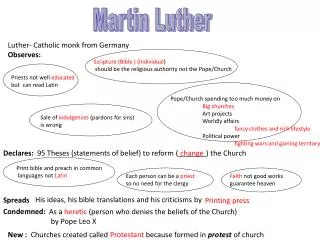
Luther’s theological breakthrough • Questions: • What is Luther's concept of faith? What is his concept of sin?(Sources 2.3, 2.4) • How does Luther understand the distinction between law and gospel? • What teachings are the foundation for the practice of issuing indulgences? How do such teachings conflict with Luther's new insights? (Sources 2.6-2.10) • Penitential system: contrition vs. attrition
The theses: debate • Compare the theological and ecclesiological implications of sources 2.10 and 2.11
Preface to Romans • Continue to examine Luther's understanding of the terms "sin," "law," "grace," and "faith." • How does he interpret the Genesis story to support his understanding? • Pay attention to Luther's use of "justice," "flesh," and "spirit." • How does Luther describe the Jews? What does he believe is the relationship between the Gospel on the one hand and the law and the prophets on the other? • To what extent do humans exert effort? Compare Luther's teachings with those of Thomas a Kempis. • What is the role of suffering in the process of coming to God? Again, compare Luther with the Imitation of Christ.