Efficient Lighting Solutions at The Gurdon Institute
Learn how The Gurdon Institute reduced energy consumption through smart lighting solutions, including trials, outcomes, and cost analysis.

Efficient Lighting Solutions at The Gurdon Institute
E N D
Presentation Transcript
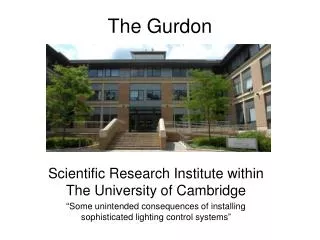
The Gurdon Scientific Research Institute within The University of Cambridge “Some unintended consequences of installing sophisticated lighting control systems”
Kathy Hilton • Technical support and Building Facilities Manager • Environmental knowledge and background until early 2012 - none! • Summarise the Institute and then talk about our experiences with lighting
How we embarked on energy saving campaign • The Gurdon is a small Institute (7070m2) • Generate third highest carbon emissions within the University • In academic year 2010/11 we used 5M kW electricity and 4.5M kW gas. • In late 2011 we volunteered to became a University “pilot” department to explore ways to reduce our carbon footprint
Gurdon energy usage compared to other ‘pilot’ departments m2
Monitoring & visual data • Only had one figure for electricity and one for gas - that of our mains meters • The first stage as a pilot department was to have electrical sub-metering installed by Building Sustainability Ltd. • ‘Tracker’ allowed us to monitor, identify & target areas for reducing electrical consumption
Summary snapshot of Gurdon Electrical usage (Feb 12) 47.2% Workzones 42.2 % Climate 10.6% Services Workzones = our laboratories and support rooms including lighting circuits
Starting with Behaviour Change • Engaging scientists and getting them on board – reduce waste by switching off • Using their natural competitiveness we launched an energy reduction competition • Asked for energy saving ideas • Gurdon Lighting. • 1062 light fittings, maximum of 550,000 kwh per annum or 10% of total building electricity • Free lighting surveys suggest 50% reduction
Is a lighting retrofit value for money? • Financial cost • Surveys suggested £54K to £65K • Energy saving of 50% with 3 year payback • But not comparable due to different assumptions • Scientific downtime cost • 24/7 Institute • Working around scientists or stopping works • Management time of works • Environmental disposal cost • Why throw away (recycle!) working lights
Lighting Trial 1 - equipment room • Communal area ( ~ 50m2) where scientists come and go to use equipment • 12 light fittings (of 72 watt) withT8 fluorescent tubes (room total 864 watts) • encouraged switching off of lights – but this did not always happen • Researchers are often carrying items • Lights frequently left on all night • Room is “unloved” as no one person takes responsibility or “owns” the space
Lighting trial 1 - wireless occupancy sensor • Installed 2 x Lutron Ranio sensors set to 15 min timeout and a partner switch. • Set to occupancy – so detected people when entering and automatically timed out. • But encouraged the light switch to be left alone • Once people got used to it, reduced timeout to 5mins • Result was a 65 - 70% reduction in this room (460kW/month to 130kW/month)
Lighting Trial 1 equipment room Wireless Lutron sensor & switch
Day profile – red manual (July 2012); green with sensors (Aug 2013) Annual profile – from July 2012 (red) compared to Aug 2013 (green)
Lighting 2 - trial lab • Laboratories are about 100 m2 • A mixture of fluorescent T8 tubes and down lighters ~ 1000 watts total • Multi gang light switches – manually switched on/off • Typically lights are on all day (and sometimes at night) • Lutron part wireless solution = flexibility • Utilised dual technology sensors (PIR & Ultrasonic). Very minor motion in lab (microscopes etc).
Lighting trial 2 involved • Dimmable ballasts installed for daylight harvesting • T8s change to T5s • Occupancy sensing throughout lab • Switching repositioned for ‘fine’ local control (in individual bays) Green – manual switching Red - occupancy
Typical Day –after sensors were adjusted for vacancy (red) Trial to date (July 2012 to Aug 2013) 2012 2013
Unintended Consequences • Our researchers’ behaviour had a positive effect on manual switching of lights – especially in ‘owned’ areas but less so in ‘unloved’ areas • Automatic occupancy sensors altered the thresholds (max & min watts) but not as expected, hence change to vacancy • Use of space and its occupants are key • “One size does not fit all”
Lighting Trial 3 - LED flat panels • Foyer area used fluorescent spot = 504 watts. Now have LED flat panels = 112 watts • Intend to install in our corridors which are on 24hours. Estimate a 70% reduction (from 54,000 kW to 16,000 kW per year) • Incorporate wireless controls that will set the light level to the correct level and then dim down to 10%.
Outcomes • The Gurdon has installed 97 Ranio sensors (trial 1) in other ‘unloved’ areas such as equipment rooms, support rooms, offices and toilets. • These wireless Lutron sensors are to be rolled out across the University estates in other ‘unloved’ areas. • Based on this trial the University has allocated a budget to tender for the survey, purchase and installation for 50 buildings, and plan to include air conditioning controls as well.
Thank You Questions ?