Download
1 / 5
50 likes | 189 Vues
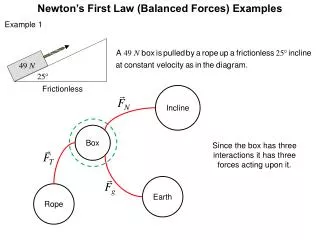
Explore Newton's First Law through a detailed example involving a box on a frictionless incline. This scenario analyzes the box's three interactions: gravitational force, tension from a rope, and normal force. Step-by-step, we draw a force diagram, addressing how to simplify motion to one dimension. We also formulate equations for parallel and perpendicular forces, demonstrating how to calculate the force required to pull the box up the incline at a constant velocity and the normal force acting on the box.

E N D
Newton’s First Law (Balanced Forces) Examples Example 1 Frictionless Incline Box Since the box has three interactions it has three forces acting upon it. Earth Rope
Newton’s First Law (Balanced Forces) Examples Example 1 Frictionless a. Draw a force diagram for the box. Remember, rotate the axis to make the motion one dimensional!
Example 1 Frictionless a. Draw a force diagram for the box.
Example 1 continued Frictionless b. Write an equation for the parallel forces and components. What force is needed to pull the box up the incline at constant velocity? But
Example 1 continued Frictionless c. Write the equation for the perpendicular forces and components. Calculate the normal force acting on the box. But