Exploring Human Anatomy and Physiology: Structure, Function, and Biological Organization
This comprehensive introduction to A&P anatomy and physiology delves into the essential concepts of biological organization, characteristics of life, and the human body’s structure. Learn about the levels of biological organization from cells to ecosystems, discover the defining traits of living organisms, and examine body planes and anatomical terms. Gain insight into directional terms, body cavities, and the various regions of the body. This foundational knowledge is crucial for understanding how anatomical and physiological principles interrelate.

Exploring Human Anatomy and Physiology: Structure, Function, and Biological Organization
E N D
Presentation Transcript
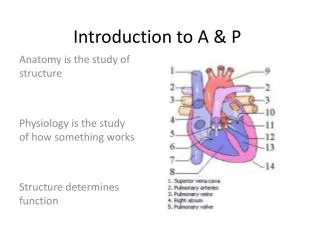
Introduction to A & P Anatomy is the study of structure Physiology is the study of how something works Structure determines function
I. Levels of biological organization • Chemical • Cell • Tissue • Organ • Organ system • Organism • Population • Communities • Ecosytems • Biosphere
II. Characteristics of lifeA. Living things are made of cells • 1. procaryotic vs. eucaryotic • 2. plant vs. animal cells • 3. surrounded by a cell membrane that is semipermeable • 4. common genetic language • 5. science of cellular study is called cytology
C. Living organisms exhibit respiration • 1. organisms take in energy • 2. convert energy to build new cells • 3. use energy to maintain homeostasis
D. Living organisms maintain homeostasis • 1. definition • 2. maintained by feedback systems • 3. components of feedback systems • 4. types of feedback systems • a. Negative • B. Positive
III. Body Planes • Anatomical position • Body planes 1. Longitudinal a. Sagittal (mid vs. para) b. Coronal (Frontal) 2. Transverse (Horizontal)
IV. Directional terms • 1. lateral vs. medial • 2. dorsal vs. ventral • 3. anterior vs. posterior • 4. cranial vs. caudal • 5. superior vs. inferior • 6. superficial vs. deep
V. Anatomical Regions • 1. Abdominolpelvic quadrants
VI. Body Cavities • A. Dorsal body cavity • 1. cranial cavity • 2. vertebral or spinal cavity • B. Ventral body cavity (viscera) • 1. abdominal (peritoneum) 2. thoracic a. pleural cavities b. mediastinum
VII. Membranes • A. Mesentery • B. Visceral vs. parietal serosa • C. Hand in balloon • D. Heart membranes • E. Lung membranes • F. Peritoneal membranes • G. Serosal fluid • H. Pleurisy or peritonitis
VIII. Body Regions • A. Abdominal • B. Antecubital • C. Axillary • D. Brachial • E. Buccal • F. Cervical • G. Femoral • H. Gluteal • I. Inguinal • J. Lumbar • K. Occipital • L. Popliteal • M. Pubic • N. Scapular • O. Sural • P. Umbilical