Download
1 / 25
250 likes | 370 Vues
This lecture provides an in-depth review of first-order highpass and lowpass filters, focusing on their cutoff frequencies and frequency response results. It explores time-to-frequency domain relations and the significance of Bode plots for analyzing filter behavior. Key educational content is drawn from relevant chapters on circuits categorized by amplitude response, emphasizing the operation of these filters at low and high frequencies. The session integrates practical examples to demonstrate amplitude response checks and the utility of logarithmic scales in Bode plots, enhancing comprehension of filter dynamics.

E N D
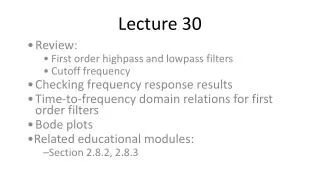
Lecture 30 Review: First order highpass and lowpass filters Cutoff frequency Checking frequency response results Time-to-frequency domain relations for first order filters Bode plots Related educational materials: Chapter 11.3, 11.4
Filters • Circuits categorized by their amplitude response • Filters “pass” some frequencies and “stop” others • Lowpass filters pass low frequencies • Highpass filters pass high frequencies • Filters are also categorized by their order • The filter order corresponds to the order of the circuit’s governing differential equation • Circuits I: only first order low- and highpass filters
First order filters • Review: Low- and highpass filter response examples • Cutoff frequency separates the pass- and stopbands • Where the amplitude response is times the max amplitude
Annotate previous slide to show cutoff frequencies • Note that cutoff frequency is related to maximum gain of filter • Change max gain on figure (write in) => gain at corner frequency changes
Time vs. frequency domain characterization • In the time domain, we characterized first order circuits by their step response • DC gain, time constant ( ) • We can likewise characterize first order circuits by their frequency response • DC gain, cutoff frequency (c)
On previous slide, sketch step response, show DC gain • Then show that cosine input becomes a step input as frequency -> zero
Time-to-Frequency domain relations – cont’d • Governing differential equation for first order system: • Converting to frequency domain:
On previous slide, show: • (1) time domain DC gain, tau • (2) conversion to frequency response => u(t)=Ue^(jwt), etc. • (3) freqency response -> magnitude response • (4) DC gain and cutoff frequency from mag. Resp.
Checking amplitude responses • We can (fairly) easily check our amplitude responses at very low and very high frequencies • Capacitors, inductors replaced by open, short circuits • Results in purely resistive network • Analyze resistive network, and compare result to amplitude response • Provides “physical insight” into low, high frequency operation
Inductors at low, high frequencies • Inductor impedance: • = 0 • Inductor behaves like short circuit at low frequencies • • Inductor behaves like open circuit at high frequencies
Capacitors at low, high frequencies • Capacitor impedance: • = 0 • Capacitor behaves like open circuit at low frequencies • • Capacitor behaves like short circuit at high frequencies
Example – checking amplitude response • What is the amplitude response of the circuit below as 0 and ?
Bode plots – introduction • We have used linear scales to plot frequency responses • Selective use of logarithmic scales has a number of advantages: • Amplitudes and frequencies tend to span large ranges • Logarithms convert multiplication and division to addition and subtraction • Human senses work logarithmically • Bode plots use logarithmic scales to simplify plotting of frequency responses and interpretation of plots
Do demos on previous slide • Note large ranges of frequencies; sensitivity to frequency ranges • Note human senses work logarithmically
Nomenclature relative to log scales • Logarithmic scales convert multiplicative factors to linear differences • Some of these multiplicative factors have special names • A factor of 10 change in frequency is a decade difference on a log scale • A factor of 2 change in frequency is an octave difference on a log scale
Bode Plots • Bode plots are a specific format for plotting frequency responses • Frequencies are on logarithmic scales • Amplitudes are on a decibel (dB) scale • Phases are on a linear scale
Decibels • Named for Alexander Graham Bell • Common gains and their decibel values: 10 20dB 1 0dB 0.1 -20dB 0.5 -6dB -3dB
Bode plots of first order filters • Frequency response for typical first order lowpass filter: • Magnitude, phase responses:
Annotate previous slide to show asymptotic behavior, -3dB point at wc, intersection of asymptotes is at wc • Note that I can muliply this by a gain, without affecting the shape of the curve – it simply moves up and down
Annotate previous slide to show asymptotic behavior, -45 degrees at wc
Example • Sketch a Bode plot for the circuit below.