Evaluation of Boundary Blend Practices in WRF for 5, 15, and 45 km Domains
This study analyzes the impact of boundary blending (BD) versus non-boundary blending (NBD) in the WRF model over different domains (5 km, 15 km, and 45 km) during a full update cycle. Conducted on two distinct experiments representing data assimilation and integration periods from October 2108, key metrics such as 500 hPa vorticity and the diffs between BD and NBD are examined every 6 hours. The findings reveal significant differences in model outputs related to the boundary blending approach, highlighting the importance of methodology in numerical weather prediction. Further experiments are proposed for thorough investigation.

Evaluation of Boundary Blend Practices in WRF for 5, 15, and 45 km Domains
E N D
Presentation Transcript
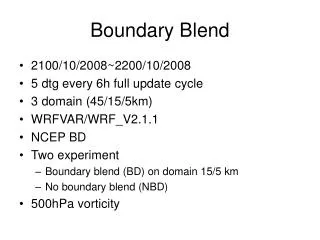
Boundary Blend • 2100/10/2008~2200/10/2008 • 5 dtg every 6h full update cycle • 3 domain (45/15/5km) • WRFVAR/WRF_V2.1.1 • NCEP BD • Two experiment • Boundary blend (BD) on domain 15/5 km • No boundary blend (NBD) • 500hPa vorticity
Code Verify-500 Vor Diff 2106 ana 2100 06f 2100 ana 2106 06f 2112 ana 2112 06f
NBD BD 500hPa Vor 2008/10/2100
500 hPa Vor_Diff 2008/10/2100
NBD BD 500hPa Vor 2008/10/2106
500 hPa Vor_Diff 2008/10/2106
NBD BD 500hPa Vor 2008/10/2112
500 hPa Vor_Diff 2008/10/2112
NBD BD 500hPa Vor 2008/10/2118
500 hPa Vor_Diff 2008/10/2118
NBD BD 500hPa Vor 2008/10/2200
500 hPa Vor_Diff 2008/10/2200
21/18 11h f 21/18 12h f NBD 21/18 11h f 21/18 12h f BD BD is better
BD 2200 6h f 2200 9h f 2200 12h f NBD 2200 9h f 2200 12h f 2200 6h f
After 5 dtg full update cycle run, difference at end date is obviously. • Unknown the reason to cause this difference by the effect of integration or by the BD big forcing • Redo the experiment to do extend to 7 dtg full update cycle run