Download
1 / 5
50 likes | 168 Vues
Explore how historians and archaeologists study the cultures of the past. Archaeologists dig up and examine artifacts—handmade objects that offer insights into ancient civilizations—while historians analyze primary sources, firsthand accounts of events. Learn about key concepts such as civilization, revolution, and imperialism, and how these dimensions shape our understanding of history. This guide delves into the methods and terminologies used by these experts to uncover the narratives of human life and heritage.

E N D
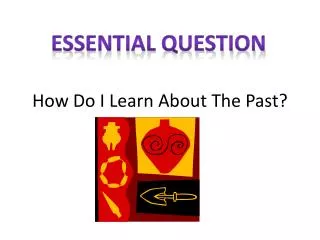
ESSENTIAL QUESTION How Do I Learn About The Past?
Historians & Archaeologists • To identify types of objects archaeologists use to learn about cultures of the past • To identify types of documents historians use to learn about the past
He vocabulary • Civilization: A group of people who have cities and government • Archaeologist: A scientist who studies cultures of the past by digging up and examining the remains of ancient towns and cities • Artifact: A handmade object, such as a tool or weapon • Historian: Someone who writes about the past; an expert in history • Border: The dividing line between two countries • Primary source: A first hand account of a historical event
VOCABULARY History: The record of past events and the story of what happened to people in the past Slavery: The owning of human beings with the belief that they are property Revolution: A complete change especially in a way of life or a government Industry: Business and manufacturing Agriculture: The use of land for growing crops and raising animals; farming Development: Growth of something Imperialism: The practice of conquering other lands or controlling the government and wealth of weaker lands
Culture: The way of life—religion, ideas, arts, tools of a certain people in a certain time AD: ( Anno Domino) Dating from the time Jesus Christ was born BC:( Before Christ) Dating from before the time Jesus Christ was born VOCABULARY