Alan Mclelland
This report by Dr. Alan McLelland discusses the increasing dependence on critical metals like indium, lithium, and neodymium in various advanced technologies including electric vehicles, renewable energy, and electronics. With the U.S. and Europe as significant importers, the supply of these essential materials is lagging behind demand, highlighting the need for sustainable sourcing and recycling. The report emphasizes the importance of substituting and optimizing the use of technology metals to mitigate future supply issues and ensure efficiency in manufacturing processes.

Alan Mclelland
E N D
Presentation Transcript
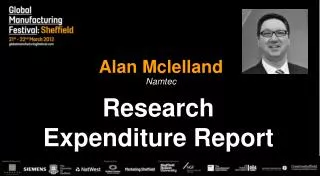
Alan Mclelland Namtec Research Expenditure Report
Critical Metals: Impact and Opportunities 22nd March 2012 Dr Alan McLelland
Critical Metals • Indium • Lithium • Neodymium
Rate of metal consumption • Rate of usage is escalating
New metals • Changes in the metals that we need
Sources have changed • Both Europe and the USA became significant net importers of raw materials / within finished goods • Low cost sources have got smart!
What is the impact? • ‘Technology Metals’ have a key role for the future • Offshore Wind – neodymium and dysprosium • Nuclear – hafnium • Solar – tellurium, gallium tellurium • Electric Vehicles - neodymium and dysprosium, lithium, colbolt • Aerospace – rhenium and ruthenium • Flat Screen Displays – indium • Electronics – huge array (gallium, tantalum, PTG)
Do we have a problem? • If you are the seller – clearly not • A key issue is we are setting out a future which builds in a reliance on these technology metals • Supply scenario is currently far behind the projected need • All can be mitigated • Don’t have use permanent magnets, don’t have to use lithium based batteries ………. • Lot of attention to substitution but real concern over timescale and potential for success
What can we do? • ‘Nothing’ ‘problems too big for us’ ‘has to be government’ • Practical level • Awareness of the role these play in your business and its future • Can we use less? • Can you substitute? • Can you use a metal that is not derived as a by product? • Manufacturing efficiency?
Let’s recycle? • Smart phone contains ~ 25mg gold • How many? • Equates to around 40 tonnes of gold • 400 tonnes of silver, 14 tonnes of palladium, 14,000 tonnes of copper, 6000 tonnes of cobalt …………. • 1 product waste stream • Commercially, does it have legs? • BUT
Let’s recycle? • Capture very little – need it now • Isolate and separate • Capture of individual metals is technically challenging • small quantities, widely distributed, thin layers, combined into components, alloyed, physically integrated …… • Area of considerable challenge, development but opportunity • Are making progress but will it be in time? • Ought to do better than today……..