Understanding Alkali Metals: Properties, Reactivity, and Applications
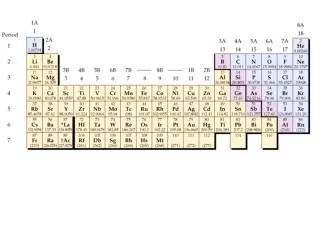
Alkali metals, found in Group I of the Periodic Table, are highly reactive and include lithium, sodium, potassium, rubidium, cesium, and francium. These metals vigorously react with water, producing hydroxides and releasing hydrogen gas. Lithium, the lightest, has unique properties and requires safe handling due to its flammability. Sodium and potassium are vital for biological functions, while rubidium, cesium, and francium showcase extreme reactivity. Explore the essential characteristics and significance of these elements in both chemistry and everyday life.

Understanding Alkali Metals: Properties, Reactivity, and Applications
E N D
Presentation Transcript
Alkali Metals Jackie Wilson
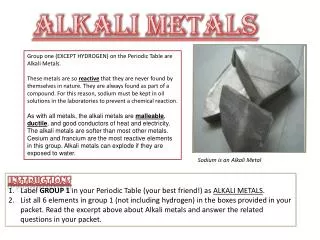
Alkali metals Group I of the Periodic Table is composed of highly reactive metals. They react vigorously with water to produce hydroxides and release hydrogen. They easily lose a valence electron an form an ion with a 1+ charge and there soft enough to cut like butter
lithium • It is the lightest alkali metal there found In water soil an rocks. An the least reactive • Lithium has a melting point of 180.54°C • boiling point of 1342°C • specific gravity of 0.534 (20°C) • valence of 1. • It is the lightest of the metals, with a density approximately half that of water. • Lithium imparts a crimson color to flame, although the metal itself burns a bright white. • Lithium is corrosive and requires special handling. Elemental lithium is extremely flammable.
Sodium & Potassium • There the most abundant alkali metals. Potassium is more reactive than sodium but humans an vertebrates must both their diets because many biological functions are controlled by them.
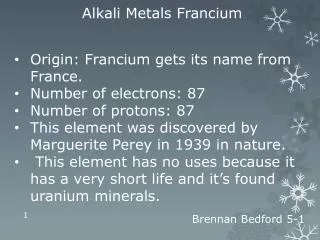
Other alkali metals • The most reactive alkali metals Rubidium, Cesium and Francium. Rubidium with a melting point at 40 degrees celsius melts on a hot day. And it will burst into flames if exposed to air. Francium the most reactive alkali metal
sources • Chem4kids.com • Chemistry Resources: The Elements: Alkali Metals • www.scienceclarified.com