
SlideServe
Menu
Préférences
© SlideServe · v2026

Identify Computer System Components

aloysius avatar
9 diapositives · 198 Views · Feb 05, 2013

Learn about the various components of a computer system: monitor, keyboard, mouse, CPU, disks drives, and more. Explore how they work together to make your computer function efficiently.
Identify Computer System Components - slide 1
01 / 9Identify Computer System Components
1 / 17

Télécharger la présentation

Identify Computer System Components
Une image / un lien ci-dessous est fourni (tel quel) pour télécharger la présentation

Politique de téléchargement : le contenu du site vous est fourni TEL QUEL pour votre information et votre usage personnel ; il ne peut être vendu, concédé sous licence ni partagé sur d’autres sites sans l’accord de son auteur.Le contenu vous est fourni TEL QUEL, pour votre information et votre usage personnel uniquement. Téléchargez la présentation en cliquant sur ce lien. Lors du téléchargement, si vous ne parvenez pas à télécharger une présentation, l’éditeur a peut-être supprimé le fichier de son serveur.Pendant le téléchargement, si vous ne parvenez pas à obtenir une présentation, le fichier a peut-être été supprimé par l’éditeur.

F I N

Plus de contenu associé

Transcription de la présentation
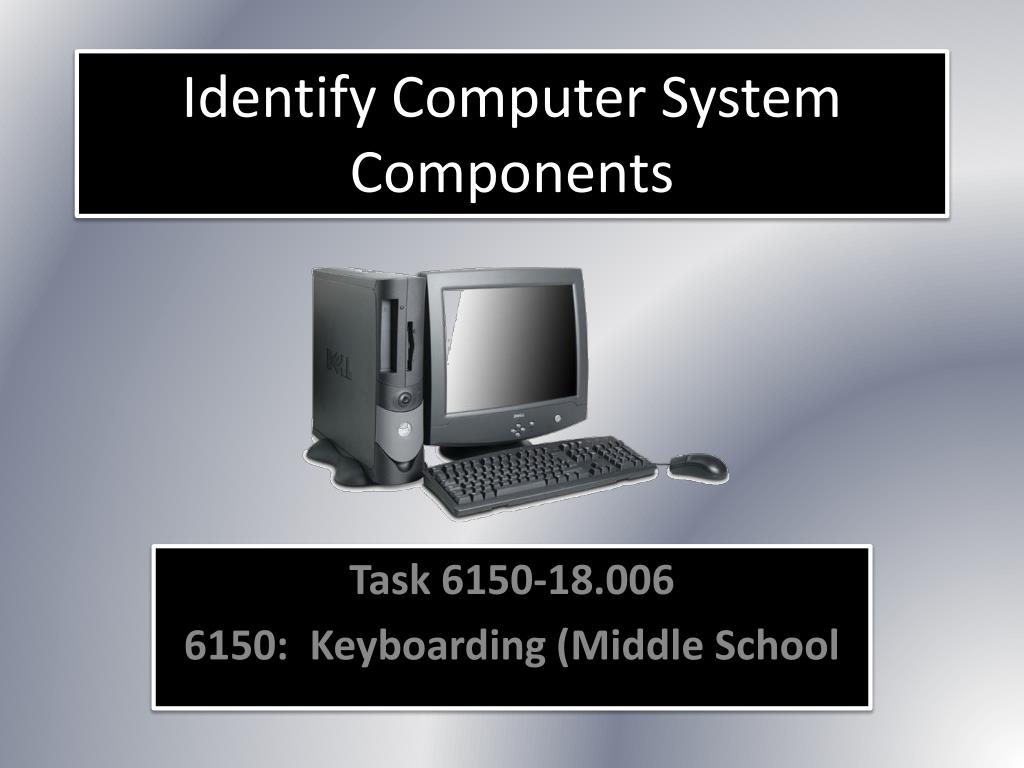
  1. Identify Computer System Components Task 6150-18.006 6150: Keyboarding (Middle School

  2. Take a look at the computer in front of you. No, not just the screen. Look at all of the other parts. Do you know what they are? Do you know what they do? If you already know - great! Give yourself a big pat on the back! But if you don't know about all the gadgets surrounding your computer, then read on and find out! Outer Hardware

  3. Output devices display information in a way that you can you can understand. The most common output device is a monitor. It looks a lot a like a TV and houses the computer screen. The monitor allows you to 'see' what you and the computer are doing together.

  4. The keyboard is an input device. You use it to get new information into a computer. The keyboard has keys for letters, numbers, punctuation marks and special commands. Pressing the keys tells the computer what to do or what to write.

  5. The mouse has a special ball that allows you to roll it around on a pad or desk and move the cursor around on screen. By clicking on the buttons on the mouse, you give the computer directions on what to do.

  6. The brain of a computer is the CPUor Central Processing Unit. Like a brain, it controls information and tells other parts what to do. The type of CPU in a computer also determines how fast that computer can operate. A CPU generates lots of heat, so there is usually a small fan nearby to cool it down.

  7. Your computer case probably has a place to insert floppy disks or CDs. These are called the floppy disk driveand the CD-ROM drive.

  8. The floppy disk drive reads information from a very thin disk that is inside a flat, square plastic case.

  9. CD-ROM is short for Compact Disk - Read Only Memory. A compact disk is a shiny, circular disk that stores information. A CD-ROM can only read information from the disk.