
SlideServe
Menu
Préférences
© SlideServe · v2026

9.8 Graph Coloring

alta avatar
10 diapositives · 1.2K Views · Jul 24, 2014

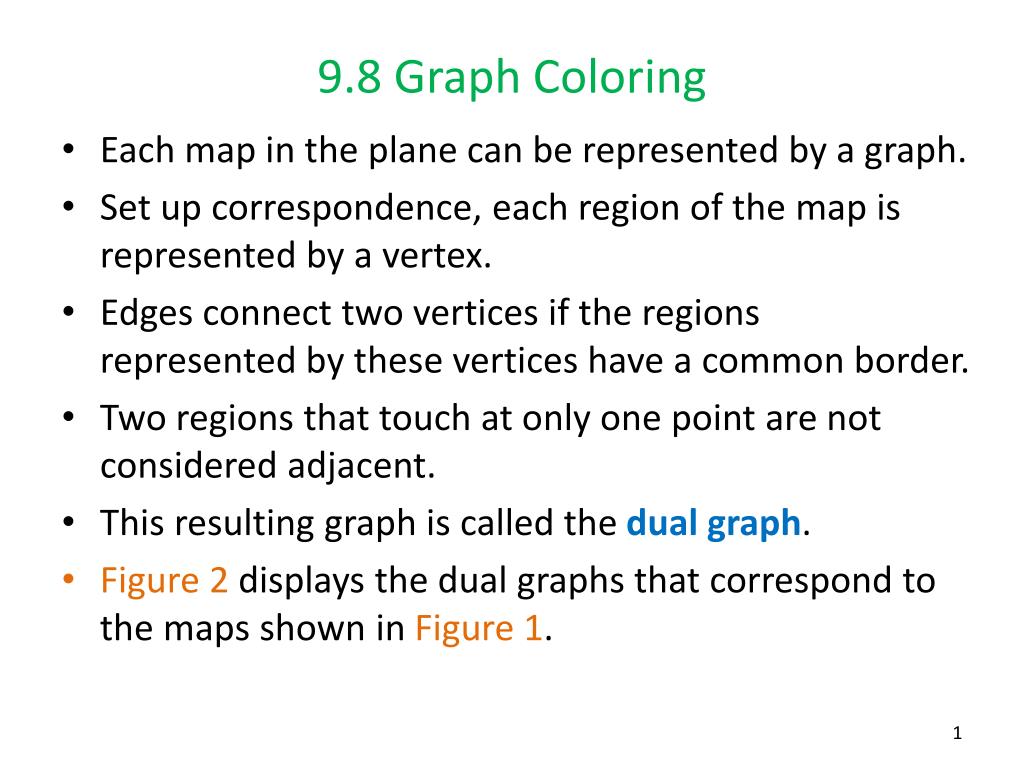
9.8 Graph Coloring. Each map in the plane can be represented by a graph. Set up correspondence, each region of the map is represented by a vertex. Edges connect two vertices if the regions represented by these vertices have a common border.
9.8 Graph Coloring - slide 1
01 / 109.8 Graph Coloring
1 / 17

Télécharger la présentation

9.8 Graph Coloring
Une image / un lien ci-dessous est fourni (tel quel) pour télécharger la présentation

Politique de téléchargement : le contenu du site vous est fourni TEL QUEL pour votre information et votre usage personnel ; il ne peut être vendu, concédé sous licence ni partagé sur d’autres sites sans l’accord de son auteur.Le contenu vous est fourni TEL QUEL, pour votre information et votre usage personnel uniquement. Téléchargez la présentation en cliquant sur ce lien. Lors du téléchargement, si vous ne parvenez pas à télécharger une présentation, l’éditeur a peut-être supprimé le fichier de son serveur.Pendant le téléchargement, si vous ne parvenez pas à obtenir une présentation, le fichier a peut-être été supprimé par l’éditeur.

F I N

Plus de contenu associé

Transcription de la présentation
  1. 9.8 Graph Coloring • Each map in the plane can be represented by a graph. • Set up correspondence, each region of the map is represented by a vertex. • Edges connect two vertices if the regions represented by these vertices have a common border. • Two regions that touch at only one point are not considered adjacent. • This resulting graph is called the dual graph. • Figure 2 displays the dual graphs that correspond to the maps shown in Figure 1.

  2. Graph Coloring FIGURE 1 Two Maps. FIGURE 2 Dual Graph of the Maps in Figure 1.

  3. Graph Coloring • Definition 1: A coloring of a simple graph is the assignment of a color to each vertex of the graph so that no two adjacent vertices are assigned the same color. • Definition 2: The chromatic number of a graph is the least number of colors needed for a coloring of this graph. The chromatic number of a graph G is denoted by χ(G) .(Here χ is the Greek letter chi)

  4. Graph Coloring • Theorem 1: THE FOUR COLOR THEOREM The chromatic number of a planar graph is no greater than four. • Example 1: What are the chromatic numbers of the graphs G and H shown in below? FIGURE 3 The Simple Graphs G and H.

  5. Graph Coloring FIGURE 4 Colorings of the Graphs G and H.

  6. Graph Coloring • Example 2: What is the chromatic number of Kn? FIGURE 5 A Coloring of K5.

  7. Graph Coloring • Example 3: What is the chromatic number of the complete bipartite graph Km,n , where m and n are positive integers ? FIGURE 6 A Coloring of K3,4.

  8. Graph Coloring • Example 4: What is the chromatic number of the graph Cn, where n  3? (Recall that Cn is the cycle with n vertices.) FIGURE 7 Colorings of C5 and C6.

  9. Applications of Graph Coloring • Example 5: Scheduling Final Exams • How can the final exams at a university be scheduled so that no student has two exams at the same time? FIGURE 8 The Graph Representing the Scheduling of Final Exams.

  10. Applications of Graph Coloring FIGURE 9 Using a Coloring to Schedule Final Exams.